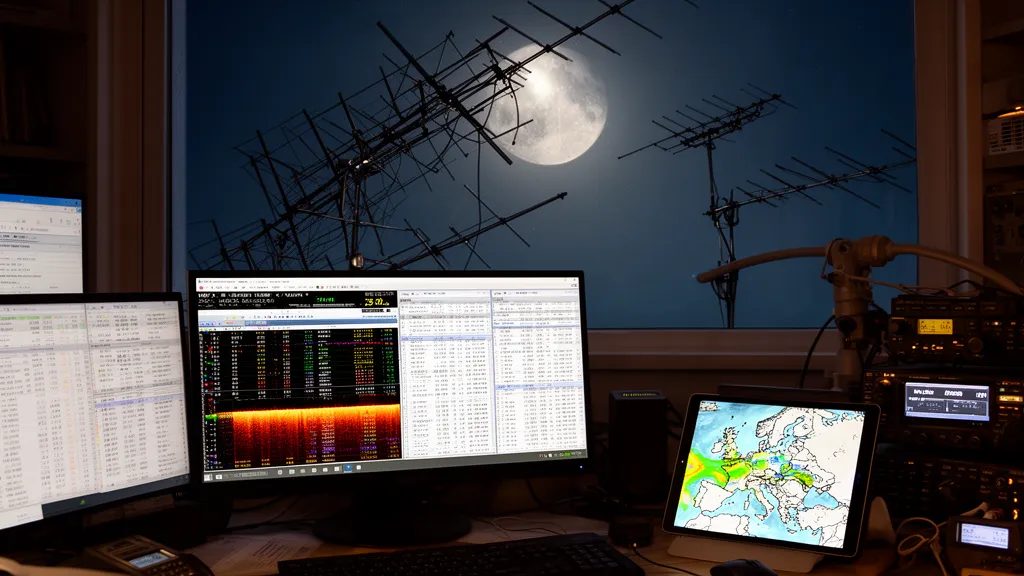
Operator’s Verdict: The 2 meter band (144–148 MHz) is the backbone of VHF DX. Beyond local FM repeaters, it supports four distinct long-distance propagation modes: tropospheric ducting (300–1,500 km), meteor scatter (100–2,000 km), aurora scatter (continental), and EME (worldwide). Each mode requires different equipment, operating techniques, and conditions.
What Makes 2 Meters the Backbone of VHF DX
The 2 meter band is the most active VHF amateur allocation globally because it sits at the intersection of achievable antenna gain, atmospheric propagation, and a large installed base of SSB-capable stations. A 9-element Yagi for 144 MHz is physically manageable on a typical rooftop, yet produces enough gain to exploit ducting and meteor scatter paths that would otherwise be out of reach.
Every major VHF contest, EME net, and meteor scatter calendar event centers on 144 MHz. Operators who stay on FM repeaters are using perhaps 5% of what the band offers. The other 95% — long-path terrestrial DX, digital meteor scatter, aurora contacts, moonbounce — lives in the 144.100–144.300 MHz weak signal segment, where SSB and CW stations have operated since the 1950s.
The band is also the primary proving ground for every new weak-signal digital mode. JT65, MSK144, and Q65 all established themselves on 2 meters before spreading to other bands. Understanding 2m DX propagation is the entry point for understanding VHF operating in general.
Pro Tip: Before attempting 2m aurora scatter, check the live aurora conditions for current Kp. Aurora scatter on 144 MHz requires Kp 6 or higher at mid-latitudes — point your beam north, not at the other station, and use CW for the best decode rate through the Doppler-spread signals.
Tropospheric Ducting: The VHF Highway
Tropospheric ducting is the most common and reliable form of 2 meter DX. When a temperature inversion forms — warm air sitting above cooler surface air — the atmosphere acts as a waveguide, trapping radio energy at altitudes below 1,000 meters and channeling it horizontally with very low loss.
A standard contact during tropo ducting is 300–600 km. Exceptional duct events extend to 1,000–1,500 km, with the current European record exceeding 2,200 km. Signals during ducting can be remarkable: an FM simplex contact at 800 km that sounds like a local repeater is not unusual during a strong inversion.
When and Where Tropo Ducting Occurs
Ducting is most frequent in:
- Summer and early autumn in temperate regions, when warm high-pressure systems park for days
- Coastal areas where the sea surface maintains temperature gradients — the English Channel, the North Sea, the Gulf of Mexico, the Great Lakes, and the Mediterranean are all productive tropo corridors
- Anticyclonic (high-pressure) weather patterns — the barometer going up is often the first sign of an incoming duct
The inversion layer typically forms at 300–1,000 meters altitude. Stations at elevated sites (hilltops, ridge lines) that put their antennas near the top of the inversion get preferential coupling into the duct. A 100 W station on a hilltop can outperform a 500 W station in a valley during ducting.
Monitoring Tropo Conditions
The DX Sherpa website and DXinfocentre.nl publish tropo propagation forecasts based on ECMWF weather model data. Look for the “ducting gradient” map — a gradient above 100 M/km over your region indicates ducting potential. PSKReporter and the DX cluster are the most reliable real-time indicators: if you see 144 MHz FT8 spots appearing from 400+ km away, a duct is open.
On the radio, tune across 144.100–144.300 MHz SSB and listen for carriers, SSB splatter, or digital waterfall activity at ranges you normally don’t hear. Call CQ on 144.200 MHz (North America) or 144.300 MHz (Europe) and point your antenna along the suspected duct axis.
Meteor Scatter: Using Space Debris as a Reflector
Every day, roughly 40–80 tonnes of meteoritic material enters Earth’s atmosphere. Most particles vaporize in the E layer at 80–120 km altitude, briefly creating a column of ionized plasma — a “meteor trail” — that reflects VHF signals before dissipating within milliseconds to a few seconds.
Meteor scatter on 2 meters works by bouncing signals off these trails. The path geometry requires both stations to see the same area of sky at E-layer altitude, which sets the practical range at 100–2,200 km with an optimum around 800–1,200 km. The signals arrive as short bursts — sometimes a fraction of a second, sometimes a few seconds — with no continuous path in between.
MSK144: The Digital Mode That Made Meteor Scatter Accessible
Before digital modes, meteor scatter on 2 meters required high power, high-gain antennas, and the ability to understand SSB audio at speeds up to 2,400 baud. MSK144 changed all of this.
MSK144 (Minimum Shift Keying, 144 ms burst period) encodes a complete exchange — callsigns and grid squares — into a 72 ms burst at the short setting and a 144 ms burst at the standard setting. The protocol is synchronized to UTC timing (even seconds for one station, odd for the other), and WSJT-X decodes bursts that are completely inaudible to human ears.
MSK144 operates on 144.360 MHz in the ARRL band plan. A practical MSK144 station for meteor scatter requires:
- Any 144 MHz SSB transceiver
- A directional antenna — even a single 5-element Yagi is functional
- WSJT-X software (free)
- An internet connection for coordinating skeds via ON4KST chat or DX cluster
Power levels of 25–100 W are typical. A 100 W barefoot transceiver with a single Yagi produces hundreds of meteor scatter contacts per year from a mid-latitude location.
The Perseids and Leonids: Scheduled DX Windows
Major meteor showers produce elevated meteor rates that dramatically increase contact rates:
| Shower | Peak Dates | Zenithal Hourly Rate | Notes |
|---|---|---|---|
| Perseids | August 11–13 | 50–100+ | Most popular for VHF ops |
| Geminids | December 13–14 | 100–150 | Bright meteors, good bursts |
| Leonids | November 17–18 | Variable | Storm years produce intense activity |
| Sporadic | Year-round | Baseline ~5/hr | Reliable background rate |
During the Perseids peak, activity on 144.360 MHz can be continuous — decodes arriving every few minutes even with modest stations.
Random vs. Scheduled Meteor Scatter
The two operating styles are random (ARRL contest mode, calling CQ on frequency) and scheduled (sked partner pre-arranged on DX cluster or ON4KST chat). Beginners should start with scheduled skeds: agree on a frequency, set your WSJT-X to the correct sequence, and begin transmitting at the top of the minute. WSJT-X handles the rest.
Aurora Scatter: When the Geomagnetic Storm Becomes a Reflector
Aurora scatter is a uniquely dramatic VHF propagation mode. During geomagnetic storms, the aurora oval expands to mid-latitudes, and the ionized curtain of auroral precipitation reflects and scatters VHF signals. The reflection is not clean — the aurora constantly shifts, creating the characteristic harsh, rasping buzz that instantly identifies aurora scatter signals. There is no mistaking aurora for tropo or meteor scatter: the audio quality degrades to something resembling AM noise, SSB voices become barely intelligible, CW is easier to read.
Requirements for Aurora Scatter on 2 Meters
Aurora scatter on 144 MHz from mid-latitudes (40–55° N) requires:
- Kp 5 or higher for stations at 50° N geomagnetic latitude; Kp 4 may suffice for stations north of 55° N
- An antenna that can be pointed north (magnetic north toward the aurora curtain)
- SSB or CW — FM is useless for aurora because the frequency modulation produces unintelligible audio on a rapidly shifting scatter path
- Patience — openings can last minutes or hours, and the reflection geometry means only certain path azimuths work at any given time
Check DXRadar’s live aurora conditions for the current Kp and aurora oval extent before going to the antenna.
What Aurora Scatter Contacts Look Like
A typical aurora scatter exchange on 144.100–144.200 MHz SSB sounds like two stations calling through a waterfall — the frequency spread is typically 100–300 Hz, and CW note quality degrades to a raspy buzz. Grid square exchanges confirm the direction, and the contact qualifies for DXCC, VHF distance awards, and VUCC.
The aurora oval geometry means that stations in the same direction from each other (both beaming north) may scatter off the same part of the curtain and make contact even without direct line-of-sight between them. Typical EU aurora scatter contacts run 400–1,500 km; North American aurora contacts reach similar distances.
EME (Moonbounce): Worldwide with Physics on Your Side
Earth-Moon-Earth (EME) propagation uses the Moon as a passive reflector. 2 meters is the most active EME band — the combination of achievable antenna gain and the Moon’s reflectivity at 144 MHz makes it the practical entry point for moonbounce.
The round-trip path to the Moon and back is approximately 770,000 km, producing a one-way free-space path loss of roughly 187 dB at 144 MHz (FSPL = 32.44 + 20·log₁₀(144) + 20·log₁₀(384,400) ≈ 187 dB). The Moon’s diffuse scattering efficiency is low, and when you account for both paths and the Moon’s effective scattering cross-section via the EME radar equation, a 144 MHz EME link budget requires closing a path with approximately 252 dB total system loss. That is an enormous number — but modern digital modes have brought it within reach of modest stations.
Minimum Station Requirements for 2m EME
| Component | Minimum (Digital) | Serious Station |
|---|---|---|
| Antenna | 4×9-el. class array | 4×9-el. to 4×17-el. array |
| Power | 200 W | 500–1,500 W |
| Preamplifier | G4DDK or equivalent, <0.35 dB NF | Same, relay-switched |
| Mode | JT65A | CW or JT65A |
| Software | WSJT-X | WSJT-X + LunarCalc |
JT65A — the predecessor mode to FT8, with longer averaging periods — can close an EME path with a modest array and a few hundred watts because it averages over 60-second transmission blocks, pulling signals well below the noise floor. A station that would be inaudible on CW can be decoded at approximately -25 dB signal-to-noise ratio in JT65A.
When to Attempt EME
EME is possible whenever the Moon is above the horizon at both stations simultaneously and the lunar declination puts the Moon at reasonable elevation (above 10° for most antenna systems). The best windows each month are around perigee (Moon at closest approach, reducing path loss by about 2 dB) and full Moon (highest night-sky temperature from the Moon’s surface reflection).
The primary EME calling frequency on 2m is 144.120 MHz. Operators post their activity and skeds to the ON4KST 144 MHz EME chat page, which is the central coordination point for the community.
Equipment: What You Actually Need for 2m DX
The gap between a repeater-only 2m station and a DX-capable station is smaller than most operators realize.
Antenna
For terrestrial DX (tropo, meteor scatter, aurora), a 9–17 element Yagi with a boom length of 2–5 meters covers all modes. Longer booms produce more forward gain and narrower beamwidth — useful for aimed DX work, but requiring a rotator. Common choices include the M2 Antennas 2M9SSB (9-element, 12.5 dBd) or the Innovantennas LFA series.
Horizontal polarization is standard for SSB/CW work. Vertical polarization is used for repeaters and FM. For EME, circular polarization (left-hand, LHCP) is used to account for Faraday rotation at moonrise/moonset.
Low-Noise Preamplifier
At 144 MHz, the sky noise temperature is low enough that your receiver’s noise figure dominates the link budget. A preamplifier with 0.3–0.5 dB noise figure, mounted at the antenna feedpoint (relay-switched to protect it during transmit), can add 5–8 dB of effective receive performance. For EME, the preamplifier is not optional — it is the most important single component in the receive chain after the antenna.
Power Amplifier
100 W is the entry point for competitive meteor scatter and tropo work. Most serious 2m DX stations run 200–600 W to a directional antenna. For EME with a small antenna, 500+ W meaningfully improves contact rates by closing marginal paths. Solid-state amplifiers from RM Italy, Tokyo Hy-Power, and Mirage are common; homebrewers use surplus cavity combiners with LDMOS transistors.
The Weak Signal Segment: Where 2m DX Happens
The core operating frequencies for 2m DX are:
| Frequency (MHz) | Mode / Use |
|---|---|
| 144.100 | CW calling, aurora CW, EME CW |
| 144.110 | EME digital (NA) |
| 144.120 | EME JT65A international calling |
| 144.140 | JT65A digital (EU) |
| 144.200 | SSB calling (NA), aurora SSB |
| 144.300 | SSB calling (EU) |
| 144.360 | MSK144 meteor scatter |
| 144.489 | FSK441 meteor scatter (legacy) |
Activity above 144.300 MHz SSB, up to about 144.600 MHz, is used for random SSB calling and sideband DX in North America and Europe during contest weekends. ARRL VHF contests (January, June, September) produce the most active periods on 2m, with hundreds of operators running high-power SSB across the weak signal segment.
Seasonal Guide: When to Operate Each Mode
Each mode has a preferred season driven by atmospheric and astronomical conditions:
| Mode | Peak Season | Trigger |
|---|---|---|
| Tropospheric ducting | June–September | High-pressure systems, temperature inversions |
| Meteor scatter | August (Perseids), December (Geminids) | Annual meteor showers; sporadic year-round |
| Aurora scatter | Variable (follows solar cycle) | Geomagnetic storm, Kp ≥ 5 |
| EME | Year-round | Lunar schedule; perigee optimal |
During solar maximum, geomagnetic storms — and therefore aurora opportunities — are more frequent. DXRadar’s aurora dashboard shows the current Kp index and aurora oval extent. Set up an alert for Kp ≥ 4 to catch aurora opportunities before they fade.
Frequently Asked Questions
How far can you communicate on 2 meters without a repeater?
Line-of-sight 2m FM typically covers 50–80 km between well-sited stations. Tropo ducting extends the range to 300–600 km routinely, with exceptional events reaching 1,500 km. Meteor scatter reaches 100–2,000 km in brief bursts. Aurora and EME provide continental and worldwide paths respectively under the right conditions.
What is the 2 meter weak signal calling frequency?
144.200 MHz is the 2m SSB calling frequency in North America. In Europe, 144.300 MHz is widely used. After making contact on the calling frequency, QSY up or down to a clear working frequency. EME calling is on 144.120 MHz internationally.
Do I need a special license for 2m DX?
No special license beyond Technician class (USA) or its national equivalent. Technicians have full privileges on all amateur bands above 30 MHz, including 2m. General and Extra class operators are also welcome — 2m DX is not restricted by license class in most countries.
What is the difference between meteor scatter and sporadic-E on 2 meters?
Both modes use ionospheric reflection, but at different altitudes and via different mechanisms. Sporadic-E forms at 90–120 km altitude as unpredictable patches of dense ionization; it can produce continuous paths lasting minutes to hours, and it extends up to about 144 MHz only during the most intense events (foEs above ~28 MHz). Meteor scatter reflection occurs at 80–120 km altitude via brief trails left by vaporizing meteors; paths are always burst-mode with no continuous propagation.
Is JT65 or MSK144 better for 2m meteor scatter?
MSK144 is designed for meteor scatter and is the correct mode for that purpose. JT65 uses 60-second transmit blocks, which are far longer than a typical meteor burst — the signal must arrive at the correct moment within the JT65 frame, wasting most of the available integration time. MSK144 uses 72 ms or 144 ms bursts that match actual meteor trail durations and recover complete contact information from a single burst.
Can a handheld radio work 2m tropo ducting?
A handheld (HT) with 5 W to a rubber duck antenna can make contact via tropo ducting if the station at the other end has a directional antenna and reasonable power. In practice, an HT on a hilltop during a strong duct has worked 400+ km paths. The limiting factor is nearly always antenna gain, not power — any directional antenna improves results dramatically over the rubber duck.