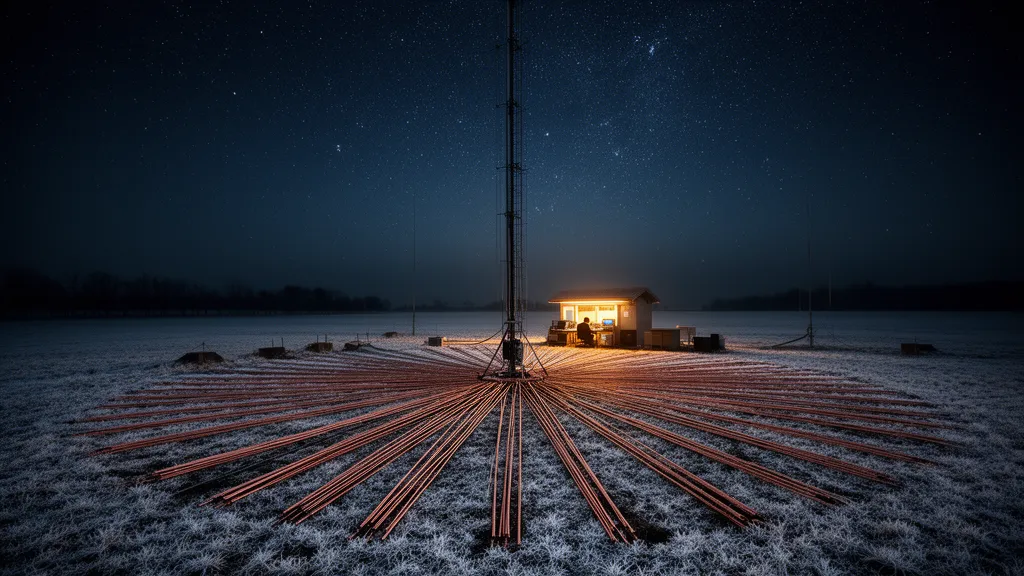
Operator’s Verdict: 160m rewards patience and antenna investment disproportionately. The band is almost exclusively a nighttime, winter proposition for serious DX. If your receive antenna cannot pull a signal out of the noise floor, no amount of transmit power will compensate. Invest in your receiving system first.
What Top Band Is and Why It Is Different
160 meters — 1.800 to 2.000 MHz — is the lowest-frequency allocation in the amateur HF spectrum and the most demanding to work effectively. It is called “Top Band” not because it is the highest-frequency band (it is the lowest), but because it was historically the highest frequency that early amateur radio operators could access. The name stuck.
Every challenge that affects other HF bands exists on 160m in amplified form:
- Antennas must be physically enormous to be efficient
- Atmospheric and man-made noise levels are the highest of any HF band
- Propagation is limited almost entirely to nighttime hours
- The usable DX window on a given path can be as short as 15–30 minutes per night
- Interference from commercial and utility stations is present in some regions
And yet a dedicated community of Top Band operators pursues 160m DX with the kind of precision and patience rarely seen on other bands. The DXCC entity list on 160m differs significantly from the same list on 20m — many geographically accessible entities have never been activated on Top Band, and some that have appeared represent unique DXpeditions organised specifically for the challenge.
Allocation and Band Plan
1.800–2.000 MHz is the standard worldwide amateur allocation (check national licence conditions — secondary status applies in some regions). The IARU and ARRL designate these primary segments:
| Segment | Use |
|---|---|
| 1.800–1.830 MHz | CW (1.800–1.810 MHz: DX window) |
| 1.830–1.840 MHz | CW (domestic) |
| 1.840–2.000 MHz | Phone (SSB) |
| 1.843 MHz | WSPR / weak-signal digital |
| 1.908 MHz | FT8 (North America primary) |
| 2.000 MHz | Upper band edge |
The 1.800–1.810 MHz window is the internationally recognised 160m DX calling segment. CW DX contacts are initiated here. The convention is: DX stations call on 1.820–1.835 MHz and listen on 1.800–1.810 MHz — a split operation that keeps the DX window uncluttered by domestic traffic.
FT8 on 160m has become increasingly active. 1.908 MHz is the primary North American FT8 frequency. European operations tend to cluster around 1.840 MHz due to the narrower phone allocation in Region 1. Verify allocations before transmitting phone above 1.840 MHz if you are in Region 1.
How 160m Propagation Works
Nighttime F2 and Ground Wave
160m DX is exclusively a nighttime proposition. During the day, D-layer absorption at 1.8 MHz is essentially total on paths beyond ground wave. The absorption coefficient for 1.8 MHz during daylight hours is such that signals transiting a daytime D-layer suffer attenuation so severe that no practical transmitter power can overcome it (ITU-R P.533-14).
Once the D-layer collapses at sunset — within approximately 45–60 minutes after local sunset at the path terminator — the F2 layer is accessible. The nighttime MUF on the F2 layer for typical mid-latitude paths exceeds 1.8 MHz under virtually all ionospheric conditions throughout the solar cycle. This means 160m propagation is, in principle, available every night of the year — unlike 10m, which requires specific SFI thresholds.
The operative constraint on 160m DX is not whether propagation exists, but whether the signal-to-noise ratio is high enough for the contact to be completed. With noise floors that can reach S9 on summer nights, a perfectly propagating signal can still be inaudible.
Ground wave propagates efficiently over salt water at 1.8 MHz. Ship-to-shore and coastal station contacts via 160m ground wave can reach 500–1,000 km over the ocean. Over average land, ground wave is useful to about 100–200 km. Highly conductive soil (coastal plains, river deltas) extends this moderately.
Path Geometry and the DX Window
For inter-continental 160m DX, both ends of the path must simultaneously be in darkness. Because 160m requires darkness more strictly than 40m or 80m (the D-layer is more aggressive at lower frequencies), the mutual darkness window is shorter.
On a typical winter Trans-Atlantic path (USA east coast to Europe):
- The optimal window is approximately 22:30–04:00 UTC in midwinter, when both regions are simultaneously in complete darkness
- This window narrows to roughly 2 hours around the equinoxes
- In summer, there may be no usable mutual darkness window at all for high-latitude paths
The grey line — the terminator between day and night — produces a brief enhancement on 160m just as it does on other low bands. In the 15–20 minutes around local sunset or sunrise, D-layer recombination or re-ionisation produces a momentary window of reduced absorption. Experienced Top Band operators time their operating to catch this window on specific paths.
Multi-Hop F2 for Very Long Paths
Trans-Pacific 160m DX (North America to Japan, Australia to Europe) requires two or more F2 hops, each supported by nighttime F2 over the mid-Pacific or Pacific–Indian ocean sectors. These paths typically open for 30–90 minutes on the best winter nights, producing signals that may be only S5–S7 even with high-power stations and excellent antennas on both ends.
The community of operators making these contacts is small. Most Trans-Pacific 160m activity is organised via reverse-beacon networks and DX clusters so that stations know when a path is actually open rather than guessing.
The Antenna Problem on 160m
Why Efficiency Is Everything
At 1.8 MHz, a quarter-wave vertical is 40m tall (approximately 130 feet). This is a structural and planning challenge for most operators. An antenna that is physically short relative to a quarter wavelength — as most practical 160m antennas are — has reduced radiation resistance and correspondingly poor efficiency unless that resistance is carefully managed.
The radiation resistance of a quarter-wave vertical over a perfect ground is approximately 36 ohms. A loading coil or shortened antenna reduces this to perhaps 5–15 ohms. Ground loss resistance of 10–30 ohms for a typical radial system means 50–85% of your transmitter power goes into the ground, not the sky. This is why the 160m antenna system, especially the ground radial system, determines more of the station’s effectiveness than the transmitter power level.
Practical Transmit Antenna Options
Quarter-wave vertical (40m): the benchmark. Feed directly with 50-ohm coax at the base. Requires a buried radial field of at least 32 radials of 0.25 wavelength (20m each). More radials always help — 120 radials of 40m each approach the ideal performance of a perfect ground plane (The ARRL Antenna Book, 25th ed.).
Inverted-L: a vertical section as tall as the support allows (typically 12–25m), then a horizontal wire making up the remainder of the quarter-wave length. The horizontal section has a less favourable radiation angle than a pure vertical but dramatically reduces the required support height. An 18m vertical section followed by a 22m horizontal section resonates near 1.850 MHz. Requires the same attention to ground radials as a vertical.
T-antenna: a horizontal wire at height with a feed lead dropping from the centre. Common in limited spaces. Less efficient than an inverted-L of the same total height but can be made to work with careful matching and a good radial system.
Loaded (shortened) vertical: a vertical of 10–15m with a loading coil at the base or at mid-point. Bandwidth is narrow (sometimes only 20–30 kHz at 2:1 SWR) and efficiency is lower than a full-size antenna. Acceptable for casual use; serious DX operators prefer a taller antenna.
Pro Tip: Every metre of added height on your Top Band vertical matters. Going from 15m to 20m vertical section reduces ground losses and improves radiation angle measurably. If you can add even 3–5m of height, do it. The ground radial system is equally critical — 16 radials at 20m length is the minimum for a serious station; 64 radials of 40m is where diminishing returns begin.
Separate Receive Antennas: Non-Negotiable for DX
On 160m, the transmit antenna’s noise floor performance is almost always inadequate for serious DX receiving. The full-size vertical that transmits efficiently is omnidirectional and has no noise rejection — it hears every S9 lightning burst and every broadband noise source equally.
Top Band stations that consistently work rare DX use separate receiving antennas with directional patterns and noise rejection:
Beverage antenna: the classic 160m receive antenna. A terminated longwire at 1–3m height, typically 250–600m long, oriented toward the desired DX direction. Provides 20–30 dB front-to-back noise rejection and very low noise temperature. Requires substantial land. Multiple Beverages in different directions allow coverage of the major DX paths.
K9AY loop: a small (2–3m) resonant loop with a remote termination resistor. Fits in a suburban yard. Provides 15–20 dB front-to-back and a noise floor 10–15 dB below a transmit vertical. Switchable between two directions. For operators who cannot erect a Beverage, a K9AY is the standard recommendation.
EWE antenna: a small loop-like antenna on two vertical supports, typically 6–10m wide and 3–5m tall. Cardioid pattern. Low cost, easy to build, moderate performance.
Large loop / Flag antenna: flat loop or “flag” shape, 1.5–3m on a side, with termination. Similar concept to the K9AY but with different shape options.
The fundamental principle: on Top Band, the station that wins is the one that hears best, not the one that transmits loudest. A 1 kW station with a dipole and no receive antenna will be worked less often than a 100W station with a proper receive array.
Noise: The Dominant Constraint
The noise environment on 160m has two components, and both must be managed.
Atmospheric noise — ITU-R P.372-16 shows the 1.8 MHz band has the highest atmospheric noise of any amateur HF allocation. In equatorial thunderstorm regions, noise levels at 1.8 MHz can exceed the receiver thermal noise floor by 50–60 dB during local thunderstorm activity. In temperate winter conditions with low local storm activity, atmospheric noise drops substantially — this is one key reason winter is Top Band season.
Man-made noise — at 1.8 MHz, every switching power supply, LED driver, solar inverter, and plasma TV is potentially an interference source. Urban and suburban 160m operators routinely face man-made noise floors of S7–S9 that obscure everything. Rural QTHs are dramatically advantaged on Top Band.
Practical implications:
- If you are in a high man-made noise environment, a directional receive antenna pointing away from local noise sources is essential
- Summer 160m DX is frustrating and often futile except from low-noise rural sites
- Monitor your noise floor before committing significant antenna resources — if your local S9 noise floor cannot be beaten, Top Band DX may require relocation or a remote receiving site
Solar Cycle and Seasonal Patterns
SFI and 160m: A Weak Relationship
Unlike the strong SFI dependence of 10m and 15m, 160m propagation is relatively insensitive to SFI. The nighttime F2 layer supports frequencies well above 1.8 MHz at virtually all phases of the solar cycle. Even at solar minimum, when foF2 might drop to 3–4 MHz at night, 160m propagation continues without interruption.
At high SFI (above 150), there is a modest benefit on 160m: the daytime MUF is elevated slightly longer into morning and evening twilight, extending the mutual darkness window on some paths by 15–30 minutes. This is a minor effect compared to the dominant influence of seasonal darkness geometry.
Winter Is Top Band Season
The northern hemisphere winter (November through February) concentrates most serious 160m DX activity for three reasons:
- Longer nights mean more hours of mutual darkness on long-path routes, especially trans-Atlantic and trans-Pacific.
- Lower atmospheric noise — thunderstorm activity in the northern hemisphere drops substantially in winter, reducing the ambient noise floor.
- Ionospheric stability — winter F2 propagation, while lower in absolute MUF than summer, is often more stable and predictable on lower-frequency paths.
The peak 160m DX months at mid-latitudes are typically December and January for Trans-Atlantic paths from North America, and November and January for Pacific paths. Spring and autumn equinox periods provide some competitive conditions but shorter windows and higher noise than midwinter.
The Top Band Community
160m supports a small, dedicated, technically sophisticated community. Several characteristics define Top Band operating culture:
Organised activity: The CQ 160-Meter Contest (held late January–early February for CW, early February for SSB) concentrates the top stations worldwide onto the band and provides the best opportunity to make 160m DX contacts that would otherwise require months of patient monitoring.
Pre-announced DXpeditions: because many operators need 160m specifically for DXCC credit, rare-entity activations on Top Band are pre-announced, usually on DX bulletins and the DX Summit. Stations monitor the activation period nightly and check the DX cluster for the operating frequency and listening split.
Reverse beacons and cluster spotting: the Reverse Beacon Network (RBN) monitors 160m CW activity worldwide. Spotting a station on RBN within seconds of their CQ tells both them and the community what paths are working right now. FT8 propagation reports through PSKReporter fill the same role for digital operators.
Power and antenna investment: Top Band DX operators regularly run the maximum legal power in their jurisdiction, combined with the largest practical antenna systems and multiple receive antennas. The physics of the band demand it. Unlike 20m or 15m where 100W and a dipole can produce DXCC, 160m DX typically requires a serious station.
Frequently Asked Questions
Why is 160m called Top Band?
The name dates from the earliest years of amateur radio, when 1.8 MHz was the highest frequency that amateurs were permitted to use. “Top Band” meant the top of the available amateur spectrum. As higher-frequency allocations were opened up through the 1920s and 1930s, the name stuck as an affectionate term for the original HF allocation.
What SFI level does 160m need?
SFI has minimal practical effect on 160m propagation. The nighttime F2 layer reliably supports frequencies above 1.8 MHz at all phases of the solar cycle. The dominant factors for 160m DX are the hours of mutual darkness on the path, the season (winter preferred), and the noise environment at both stations — not SFI.
What antenna height is needed for 160m?
A quarter-wave vertical for 160m requires a 40m (130-foot) support. Most operators use shorter alternatives: inverted-L with 12–20m vertical section, or a T-antenna. Efficiency drops with reduced height, but a well-engineered shortened antenna with a good radial field will outperform a tall but poorly grounded antenna. Ground radials are at least as important as height.
Can I work 160m DX from a small lot?
Yes, but it requires accepting compromises and investing in a good receive antenna. A loading-coil shortened vertical or a 10–15m inverted-L can transmit usably on 160m. A K9AY loop or similar directional receive antenna is essential to manage the noise floor. Many suburban Top Band operators make consistent DX contacts with systems like this — it requires patience and choosing the right operating windows.
Is 160m active during geomagnetic storms?
Less affected than higher bands, but not immune. At G1–G2 (Kp 5–6), 160m nighttime propagation is usually maintained on mid-latitude paths. At G3+ (Kp 7+), polar and auroral paths degrade and the noise floor from enhanced auroral activity can rise sharply, masking signals that would otherwise be audible. As with 80m, the lower the frequency, the more storm-resistant the propagation.
How do I get started on Top Band?
Start with what you have — any transmit antenna that presents a manageable SWR on 1.8–2.0 MHz. Then build a K9AY or EWE receive antenna before investing in a larger transmit antenna. Operate during the CQ 160-Meter Contest (January–February) when activity is highest. Monitor 1.800–1.810 MHz CW and 1.908 MHz FT8 from local sunset to local sunrise in winter. Log the paths that open and focus your antenna investment on those directions.
For companion reading, see the 80m Band Guide, 40m Band Guide, and Propagation Modes Overview.