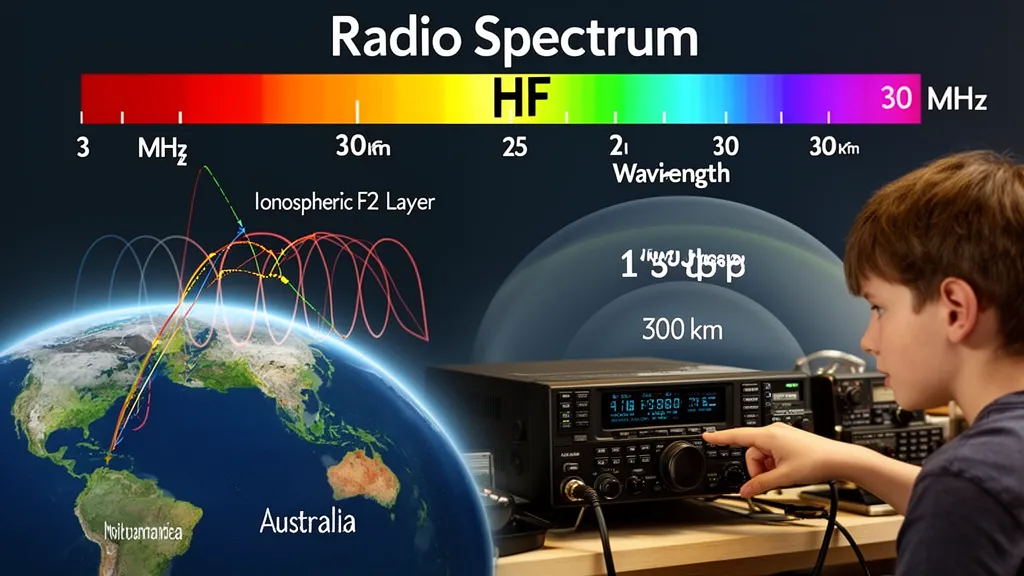
Operator’s Verdict: High Frequency (3–30 MHz) uses the ionosphere to bounce signals over thousands of kilometres without satellites or infrastructure. The primary amateur HF bands are 80m, 40m, 20m, 15m, and 10m. No internet required — just a radio, an antenna, and the ionosphere.
The Basics: What High Frequency Means
The radio spectrum is divided into named bands based on frequency range. HF — High Frequency — occupies 3 to 30 MHz. The corresponding wavelengths are 10 to 100 metres, which is why HF bands are commonly referred to by their metre wavelength (40 metres, 20 metres, etc.).
When the ITU (International Telecommunication Union) established this terminology in the 1920s, 3 MHz was genuinely high frequency by the technology standards of the time. Modern communications systems operate at millions of times higher frequencies, but the ITU nomenclature has remained consistent.
Pro Tip: New to HF? Start with DXRadar’s best bands now — it shows which bands are active in real time so you know where to tune. Pair it with the solar weather dashboard to understand why certain bands are open. Within a week of checking these before each session, you will develop an intuitive sense of HF propagation.
Why HF Is Special: The Ionosphere
What makes HF radio uniquely capable of worldwide communication is the ionosphere — a layer of the upper atmosphere containing ionised particles created by solar UV and X-ray radiation.
The ionosphere acts like a partially reflective mirror for radio waves in the HF frequency range. Waves transmitted upward from a ground station encounter the ionosphere and can be refracted (bent) back toward Earth. This “skip” can carry signals 1,000–4,000 km in a single hop. Multiple consecutive hops can carry signals to the antipodal point of Earth — roughly 20,000 km.
This mechanism — called skywave propagation — requires no infrastructure other than the transmitter and receiver. No satellites, no repeaters, no internet infrastructure. This is why HF radio remains critical for maritime communications, aviation, military, and emergency communications.
HF vs. Other Frequency Bands
Understanding HF in context of adjacent bands:
| Band | Frequencies | Propagation | Typical Range |
|---|---|---|---|
| MF (Medium Freq.) | 300 kHz–3 MHz | Ground wave + limited skywave | 0–2,000 km |
| HF (High Freq.) | 3–30 MHz | Ionospheric skywave | 0–20,000 km |
| VHF (Very High Freq.) | 30–300 MHz | Line-of-sight + special modes | 0–150 km typical |
| UHF (Ultra High Freq.) | 300 MHz–3 GHz | Line-of-sight | 0–50 km typical |
VHF and UHF pass through the ionosphere rather than being reflected. This makes them ideal for satellite communications (where you want signals to reach space) and local communications (repeaters cover a city or region). But for worldwide direct communication without infrastructure, HF is the only usable frequency range.
The Amateur HF Bands
Amateur radio operators have allocated portions of the HF spectrum for non-commercial communications. The key bands:
80 metres (3.5–4.0 MHz): Excellent for regional NVIS (Near Vertical Incidence Skywave) communication within 300–800 km at night. Long-distance DX possible overnight via multi-hop skywave. The “workhorse” for emergency communications and regional nets.
40 metres (7.0–7.3 MHz): The most consistently useful HF band. Works for NVIS (300–800 km) during the day and medium-distance DX at night. Reliable year-round across the solar cycle. The primary band for daily QSO activity worldwide.
20 metres (14.0–14.35 MHz): The premier DX band. Open for long-distance contacts (1,000–20,000 km) throughout the day under almost all solar conditions. If you can only operate one HF band, 20m provides the most consistent international access.
15 metres (21.0–21.45 MHz): Excellent DX band during solar maximum. Less reliable at solar minimum but still usable. Shorter skip than 20m, making it ideal for contacts in the 2,000–6,000 km range.
10 metres (28.0–29.7 MHz): The highest HF band. During solar maximum (SFI > 150), 10m provides outstanding global DX with modest equipment. During solar minimum, 10m can be completely closed for weeks. The band with the most dramatic variation across the solar cycle.
Who Uses HF Radio?
Amateur radio operators: Worldwide communication, contests, POTA (Parks on the Air) activations, emergency communications, technical experimentation.
Maritime: Ships at sea beyond VHF range use HF for communications with port authorities and coast guard. HF is the global emergency communication standard for maritime distress.
Aviation: HF is used for trans-oceanic flight communications where VHF radios don’t have sufficient range.
Shortwave broadcasting: International radio services (BBC World Service, VOA, etc.) transmit news and programming globally on HF.
Military and government: HF provides communication resilience independent of infrastructure.
Emergency services: ARES (Amateur Radio Emergency Service), RACES, and SHARES use HF for disaster communications when normal infrastructure fails.
Getting Started on HF
To operate HF as an amateur radio operator, you need:
- Licence: HF privileges require at minimum a General class licence in the USA or equivalent in your country
- Transceiver: Modern all-mode HF transceivers (Icom IC-7300, Yaesu FT-991A, Kenwood TS-590) cover 160m through 10m in one unit
- Antenna: Even a simple wire dipole at 10 metres height will work for HF. More sophisticated antennas improve range and efficiency but are not required to get started
- Feed line: Coaxial cable connecting antenna to transceiver
- Propagation awareness: Check DXRadar’s best-bands-now before each session to know which bands are most active
HF is uniquely accessible — a $150 antenna kit, a used transceiver, and a licence exam are all that stand between you and worldwide radio communication using only the physics of Earth’s ionosphere.
Frequently Asked Questions
What does HF stand for in radio?
HF stands for High Frequency. It refers to radio frequencies between 3 MHz and 30 MHz (wavelengths of 10 to 100 metres). The term ‘high frequency’ is historical — when this terminology was established in the 1920s, 3 MHz was considered high frequency. Today’s radio spectrum extends to hundreds of gigahertz, making HF look low by modern standards, but the nomenclature has been retained by the International Telecommunication Union (ITU). In amateur radio, HF bands include 80m, 60m, 40m, 30m, 20m, 17m, 15m, 12m, and 10m — all falling within the 3–30 MHz range.
How does HF radio communicate over long distances?
HF radio communicates over long distances via the ionosphere — a region of the upper atmosphere (60–1,000 km altitude) containing ionised particles. Radio waves transmitted upward at HF frequencies can be refracted (bent) back toward Earth by the ionosphere, completing a ‘skip’ of 1,000–4,000 km. Multiple skips can reach the other side of the world. This ionospheric propagation is what makes HF unique — VHF and UHF frequencies pass through the ionosphere rather than being reflected, limiting them to roughly line-of-sight range under normal conditions. HF can communicate globally without any infrastructure (no satellites, towers, or internet required).
What are the HF amateur radio bands?
Amateur radio HF bands (allocated by the ITU): 160m (1.8–2.0 MHz, technically MF), 80m (3.5–4.0 MHz), 60m (5 specific channels around 5.3–5.4 MHz), 40m (7.0–7.3 MHz), 30m (10.1–10.15 MHz WARC), 20m (14.0–14.35 MHz), 17m (18.068–18.168 MHz WARC), 15m (21.0–21.45 MHz), 12m (24.89–24.99 MHz WARC), 10m (28.0–29.7 MHz). The most commonly used for DX are 20m and 15m. 40m is the backbone for regional communication. The WARC bands (30m, 17m, 12m) are allocated exclusively for amateur use with no contests permitted.
What is the difference between HF, VHF, and UHF?
HF (3–30 MHz), VHF (30–300 MHz), and UHF (300–3,000 MHz) represent consecutive portions of the radio spectrum with different propagation characteristics. HF propagates via ionospheric reflection, enabling long-distance contacts without infrastructure. VHF and UHF propagate primarily by line-of-sight — useful for local communications through repeaters and simplex, but limited to roughly 50–150 km under normal conditions. VHF and UHF can achieve extended range through exceptional propagation (tropo ducting, sporadic-E on 6m) but this is the exception rather than the rule. HF is the primary band for worldwide communication; VHF/UHF for local and regional.
Do I need a special licence to use HF radio?
In most countries, operating on HF bands requires an amateur radio licence that includes HF privileges. In the USA, the Technician licence (basic exam) grants limited HF privileges on 10m and some voice frequencies on other bands. The General licence grants access to most HF bands. In the UK, the Foundation licence grants some HF privileges with power limits; the Intermediate and Full licences grant progressively more HF access. The specific licensing structure varies by country — check with your national telecommunications authority (FCC in the USA, Ofcom in the UK, ISED in Canada) for current licence class requirements.