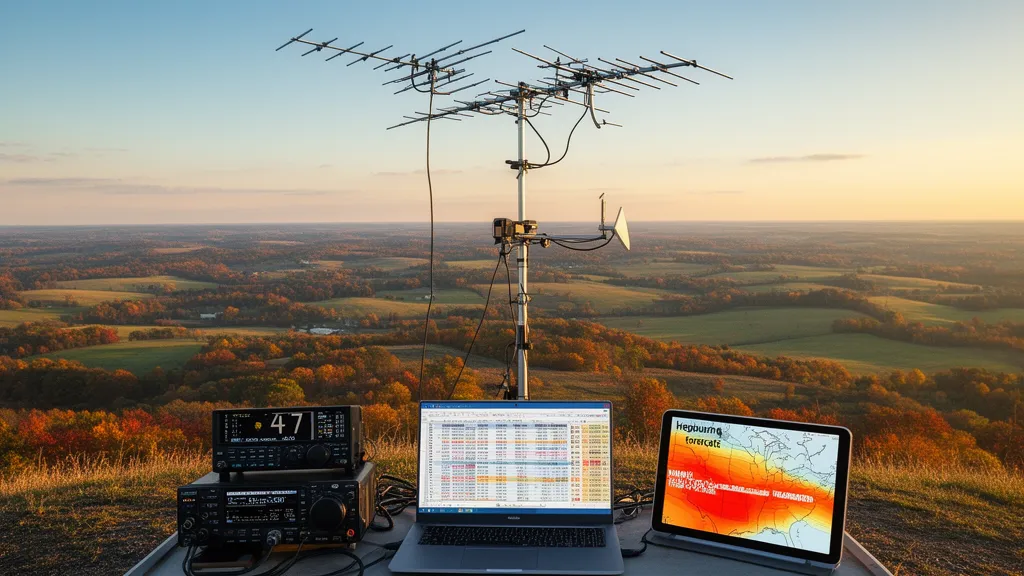
Operator's Verdict: Score = contacts × grid multipliers. Propagation events (tropo duct, Es opening) during a contest weekend can double or triple your score. Monitor the Hepburn forecast 48h before; monitor DXMaps every 30 minutes during the contest. Hilltop locations outperform valley sites by an enormous margin — elevation is the most valuable VHF contest resource.
The VHF Contest Landscape
VHF contesting occupies a unique niche in amateur radio competition. Unlike HF contesting where the worldwide propagation is always available and the challenge is operating efficiency, VHF contesting introduces a random propagation element that fundamentally changes strategy. A tropo duct, an Es opening, or a meteor shower burst during the contest window can produce more contacts in 2 hours than the rest of the contest combined.
This propagation dependency rewards operators who treat the contest as a meteorological as much as a radio event.
Pro Tip: Before any VHF contest, check DXRadar's solar weather page for Kp and SFI — elevated Kp suppresses high-latitude paths while high SFI helps 6m F2. Combine this with the Hepburn tropo forecast and best bands now for a complete pre-contest propagation picture. A 5-minute check 48 hours before the contest is worth more than an extra hour of operating.
Major Contest Rules and Scoring
ARRL VHF Contests (June and September)
Duration: 33 hours (Saturday 1800 UTC – Sunday 0300 UTC)
Bands: 50 MHz, 144 MHz, 222 MHz, 432 MHz, and higher. Most activity concentrates on 50 MHz and 144 MHz.
Scoring:
- 1 point per contact on 50 MHz
- 2 points per contact on 144 MHz
- 4 points per contact on 222 MHz and higher
- Multiplier: unique 4-character grid squares worked (all bands combined)
- Final score: sum of contact points × number of multipliers
Categories: Single Operator (All Band), Single Operator (Limited), Single Operator Portable, Rover (mobile between grids), Multi-Operator, Limited Rover.
The Rover category is distinctive to VHF contesting — an operator drives between multiple grid squares during the contest, activating each. Rovers multiply their own score by being in different grids, and also provide rare multipliers to fixed stations.
RSGB VHF National Field Day
Duration: 24 hours
Scoring: Distance-based — each QSO scores the great-circle distance in kilometres between the two stations. A 500 km contact scores 500 points; a 50 km contact scores 50 points. This directly incentivises DX contacts.
UK bands: 144 MHz primary; 50 MHz, 432 MHz, and microwave bands also active.
The distance scoring means a single tropo contact to 1,500 km scores as much as 30 local contacts at 50 km. During a strong tropo duct event, the distance-scoring system produces dramatically outsized rewards for stations positioned in the duct path.
CQ WW VHF Contest
Duration: 24 hours (July, sporadic-E season)
Scoring: Grid-based multiplier system, similar to ARRL but using 2-character grid sectors as multipliers.
Character: July timing means sporadic-E on 50 MHz is the dominant propagation factor. The contest activates a large European and North American VHF community simultaneously, maximising the pool of active stations for any propagation event.
Propagation-Based Strategy
Before the Contest
72 hours before: Check the Hepburn tropo forecast for your region. If a blocking anticyclone is developing, a tropo duct may form during the contest. This changes location strategy — coastal and hilltop stations oriented toward the duct path become preferred.
48 hours before: Review the solar flux trend. Is SFI rising (good for 6m F2/Es)? Is Kp elevated (bad for high bands)? Check DXRadar's solar weather forecast.
24 hours before: DXMaps activity map. Is Es already active in adjacent regions? If sporadic-E is building toward your region, the contest may open with an immediate 6m opening.
During the Contest
First 2 hours: Work as many local stations as possible on all available bands. These QSOs are "guaranteed" before propagation events open up DX opportunities.
Monitor DXMaps continuously: Set an alert or keep DXMaps open on a second screen. When 6m or 144 MHz starts showing spots in distant grid squares, stop everything and switch to that band. Prioritise propagation events over routine CQing.
During a tropo duct: 144 MHz becomes the primary scoring band. Rotate your antenna along the duct axis and call CQ specifically toward the duct. If the duct reaches 1,500 km, you are accessing grid squares that are impossible under normal conditions — each new grid is a multiplier.
During a sporadic-E opening on 6m: The 50 MHz score per contact is lower than 144 MHz, but the number of available contacts during an Es opening is far higher. A 3-hour Es opening with 100+ contacts more than compensates for the lower per-contact score.
Overnight (2200–0600 UTC): Tropo ducting often strengthens overnight as the atmosphere stabilises. 144 MHz duct contacts at 2 AM during an active duct are some of the most valuable of the contest. Meteor scatter on 144 MHz also contributes — during September VHF, the Perseid residual activity provides scatter contacts.
Location Selection
The single most important VHF contest decision is operating location.
What Makes a Good VHF Contest Site?
Elevation: Every 100 metres of elevation extends the radio horizon by approximately 36 km (using the standard 4/3 Earth radius model). A station at 600 m ASL has a radio horizon of ~100 km to a receiving station at ground level; the same station at 100 m ASL has ~40 km. For a contest multiplier based on grid squares, this difference translates directly to accessible grids.
Open horizon: A site with obstructions (trees, ridges, buildings) in 30% of directions loses those paths entirely. Perfect 360° exposure is the ideal.
Sea path: Coastal sites with sea exposure achieve enhanced propagation over water paths due to lower surface roughness and reduced atmospheric absorption. The North Sea, English Channel, Irish Sea, and Mediterranean paths are among the most productive for European VHF contests.
Grid boundary: If you can operate from a site on or near a 4-character grid boundary, a short move produces a new multiplier for all stations who worked you previously. Careful grid-boundary location is standard practice for top VHF rover operators.
Contest Location Examples
North America: Summits in the Appalachians, Adirondacks, and Catskills regularly host contest deployments. Mountaintop sites in Virginia and Tennessee provide line-of-sight into 6–8 surrounding grids under normal conditions.
Europe: UK sites on the Welsh mountains (Snowdon area), Scottish highlands (Cairngorms), and southern England coastal chalk hills (South Downs) produce top UK scores. German operators deploy to Bavarian Alps pre-approaches. European record-holders often use sites at 1,000–2,000 m in Alps, Pyrenees, or Apennines.
Equipment Essentials
| Component | Minimum | Competitive |
|---|---|---|
| Power | 50W | 200–500W |
| Antenna | 9-el Yagi | 17-el Yagi or stacked Yagis |
| Modes | SSB + FT8 | SSB + CW + FT8 + MSK144 |
| Bands | 50 + 144 MHz | 50, 144, 432, 1296 MHz |
| Logging | Paper | DXLab or N1MM+ VHF |
FT8 and MSK144: Modern VHF contesting increasingly uses digital modes to extend marginal contacts. During a weak tropo event, contacts at 800 km that would be inaudible on SSB are workable on FT8. ARRL VHF contests now explicitly allow and score digital mode contacts.
Using DXRadar for VHF Contest Planning
Check DXRadar's solar weather page for:
- Current Kp (elevated Kp suppresses auroral paths important for northern stations)
- SFI (determines 6m F2 potential during June contest)
- Solar flux trend (rising SFI before the contest is a positive sign)
The Hepburn tropo forecast is the external resource most critical for September VHF planning — bookmark it in early September and check daily as the contest approaches. A Hepburn forecast showing significant tropo development for your region in the 48-hour lookahead period is the single best indicator that the weekend will produce exceptional results.
Frequently Asked Questions
What are the major VHF contests?
The major VHF contests in order of activity: (1) ARRL June VHF Contest — third weekend of June, 33 hours, heavy participation, often coincides with peak sporadic-E season. (2) ARRL September VHF Contest — second weekend of September, 33 hours, prime tropo season for North America. (3) CQ WW VHF Contest — third weekend of July, 24 hours, sporadic-E season. (4) RSGB VHF National Field Day — June/July weekend in the UK, major European event. (5) RSGB VHF/UHF Contests — monthly 4-hour contests (144 MHz, 432 MHz, 1.3 GHz on rotating weekends). Monthly RSGB contests provide excellent training for the major events.
How is VHF contest scoring calculated?
In most VHF contests, score = QSOs × grid square multipliers. The ARRL system: each contact scores 1 point for local contacts (same grid or adjacent) up to 4 points for long-distance contacts, multiplied by unique 4-character Maidenhead grid squares worked. In the RSGB ODX/National Field Day system: score is based on distance (km) — each QSO scores the kilometre distance between stations, rewarding longer contacts more heavily. The RSGB distance scoring directly incentivises working DX rather than local stations, making propagation timing critical.
How do I use propagation forecasts in a VHF contest?
Check the Hepburn tropo forecast (dxinfocentre.com/tropo.html) starting 48 hours before the contest. If a tropo duct is forecast to form during the contest period, plan operating hours around it. During a duct, 144 MHz contacts to 1,500+ km become possible — these represent hundreds of additional grid squares not accessible under normal conditions. Similarly, monitor DXMaps for sporadic-E activity during June and July contests. A major Es opening during an ARRL June VHF contest can produce 200–300 additional contacts in 2–4 hours. Missing a propagation event because you took a break is the biggest lost opportunity in VHF contesting.
What is the best VHF contest operating location?
Hilltops produce dramatically better VHF contest results than valley locations. Line-of-sight is paramount on 144 MHz — elevation directly translates to additional accessible grid squares. A hilltop with 360° horizon exposure at 500 metres elevation might work 15–20 additional grids versus a valley location under normal conditions. Additionally, coastal locations (especially on headlands or cliffs) exploit sea-path enhancement — the sea surface provides a flat, low-loss propagation path compared to land paths. For ARRL VHF contests, operators deploy to mountaintops in the Rockies, Appalachians, and Sierra Nevada. In Europe, Alpine and highland UK sites produce the top scores.
Can I participate in VHF contests with a small station?
Yes, significantly. ARRL VHF contests have a 'Single Operator Portable' category specifically for temporary deployments — a tribander + 100W transceiver on a hilltop competes against similar setups, not against fixed high-gain stations. RSGB contests have an 'Open' and a 'Restricted' category separating high-power multi-antenna stations from more modest setups. Even small fixed stations can produce meaningful scores during active propagation events — a strong sporadic-E opening on 6m during the June contest is available to all. The combination of a good hilltop location + 100W + 9-element Yagi + active propagation can produce results that rival much larger fixed stations.