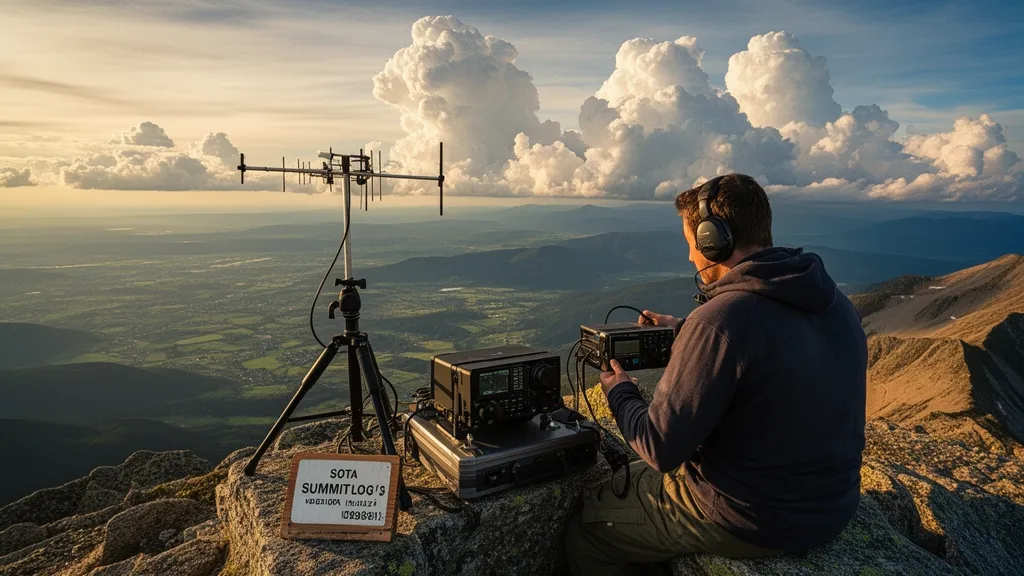
Operator’s Verdict: Elevation dramatically reduces ground clutter and enables lower take-off angles, improving DX performance even with QRP power. Plan for midday activation with a 20m/40m linked dipole, check SFI and Kp on DXRadar before leaving the car park, and alert via sotawatch.org.
The Elevation Advantage Explained
When you operate from a mountaintop, your antenna has an unobstructed view of the horizon in all directions. The take-off angle for your transmitted signal — the elevation angle at which most energy leaves the antenna — is lower compared to the same antenna surrounded by trees and terrain.
For HF DX propagation, a lower take-off angle is advantageous:
- Signals leave at shallower angles are more efficiently refracted by the F2 layer at the longer skip distances needed for intercontinental DX
- Reduced ground reflection losses on the first bounce
- Surrounding terrain at lower elevations acts as interference for signals at very low angles — the summit eliminates this interference
The practical effect: a QRP station on a high summit with a simple dipole regularly works stations that a 100-watt station at sea level cannot. This is not magic; it is reduced ground clutter and improved radiation angle.
Pro Tip: Before heading to the summit, check DXRadar’s best bands now for a live band-by-band assessment. Pair it with the solar weather dashboard to confirm SFI and Kp — a quick 30-second check from the car park tells you whether to prioritize 20m, try 15m, or focus on 40m for your activation.
Pre-Activation Planning
1. Check solar conditions: Before leaving for the summit, check DXRadar’s solar weather page. Note:
- SFI: Above 100 → plan to try 15m; above 130 → 10m worth attempting
- Kp: Below 3 → good conditions; 4+ → focus on 20m and 40m
- X-ray flux: Any M or X-class flare in the past 4 hours → expect D-layer absorption on the sunlit side
2. Alert on SOTA Watch: Post an alert at sotawatch.org at least 24 hours before your activation. Include: summit reference, date/time, bands, and modes. This allows chasers worldwide to plan to be on the air when you activate.
3. Plan band schedule: Based on SFI and time of day, plan which bands to try in sequence. A typical midday activation from a European summit:
| Band | Target | Notes |
|---|---|---|
| 20m SSB | Start | Wide reach; most chasers monitor |
| 20m CW | Follow-up | Pick up CW-only chasers |
| 40m SSB | Next | Regional chasers within 500 km |
| 15m SSB | If SFI > 100 | S2S contacts in distant regions |
| VHF/UHF | Optional | Nearby summits, local repeaters |
Equipment for Summit Operation
Weight is critical for SOTA — every kilogram carried to the summit is earned through physical effort. Target total radio kit weight under 2 kg for any activation requiring more than 1 hour of hiking.
Compact kit:
- Radio: Elecraft KX2 (370g) or KX3 (800g), Xiegu G90 (~1.63 kg), or similar
- Antenna: Sotabeams linked dipole (190g) or EFHW wire with 49:1 unun
- Battery: 3–5 Ah LiFePO4 (250–500g depending on capacity)
- Mast: 6–7m telescopic fibreglass (300–500g)
- Logging: paper (field-ready notepad) or smartphone app
Total kit: 1.5–2 kg for a 5-watt QRP setup.
Operating from the Summit
When you arrive, spend 10–15 minutes:
- Setting up the antenna and mast
- Confirming the summit reference number (critical for log uploads)
- Posting a spot to SOTAwatch.org or activating via the SOTA Goat app
- Checking your radio time sync if using FT8
Summit operating procedure:
- Begin on 20m SSB: “CQ SOTA CQ SOTA, [callsign] portable [summit reference] QRZ?”
- Work through the pileup methodically; log each contact with UTC time and frequency
- After 20–30 minutes on 20m SSB, QSY to CW, then to 40m, then higher bands if conditions warrant
- Monitor DXRadar on your phone during breaks — if 15m or 10m shows EXCELLENT, try them
The 4-QSO minimum for a valid SOTA activation is achievable in under 5 minutes on a good summit. Most operators target 20–40 contacts to ensure a satisfying activation.
S2S: Summit to Summit
Summit-to-summit contacts are the most prized in SOTA. When two activators are simultaneously active on the same band and path geometry allows it, they can work each other for bonus points.
Monitor sotawatch.org during your activation for other summits that are currently active. The website shows active spots in real-time. A 20m contact between European and North American summits during solar maximum is achievable with QRP power — the combined elevation advantage of both stations is significant.
Check current propagation conditions at DXRadar’s best bands now page to identify the best band for an S2S attempt with a specific summit.
Frequently Asked Questions
Does being on a summit improve HF propagation?
Yes, significantly. Elevation provides reduced ground clutter (fewer obstructions to outgoing waves), a lower effective take-off angle for long-distance propagation, and often less RF noise from man-made sources. A dipole at 5 metres height on a 2000-metre summit can outperform a dipole at 15 metres at sea level on certain DX paths because of the reduced surrounding terrain interference. The propagation improvement is real but varies by frequency and path direction.
What is the minimum power for SOTA success?
Most SOTA activators operate QRP (5 watts maximum for HF). With 5 watts and a simple wire antenna, contacting summit-to-summit (S2S) stations and chasers with 100-watt stations at distances of 500–5,000 km is routine during good propagation. QRO (high power) is allowed but counterproductive for portable operation — batteries are heavy, linear amplifiers add weight, and the propagation advantages of elevation partially compensate for reduced power.
What bands should I bring to a SOTA activation?
A linked dipole covering 20m and 40m covers 95% of SOTA operating scenarios. 20m is the primary DX and chasers band, open throughout the day. 40m provides NVIS regional coverage (300–600 km) when 20m skip zone excludes nearby stations. If you carry the extra wire sections, 15m and 10m are valuable during solar maximum for accessing distant S2S partners and worldwide chasers. Many SOTA operators also bring a VHF/UHF handheld for summit-to-summit contacts at close range.
When should I schedule my SOTA activation for best propagation?
Midday local time provides the best HF propagation for SOTA: F2 ionisation is at its daily peak, both 20m and higher bands are open, and daytime weather conditions are usually the most stable for operating. Avoid very early morning (20m path may not yet be established) and late afternoon (declining solar angle reduces F2 ionisation). For gray line contacts, the 30 minutes around local sunrise or sunset offer unique propagation windows.
How does SOTA scoring work?
SOTA uses a points system based on summit altitude: summits earn 1, 2, 4, 6, 8, or 10 points. A valid activation requires 4 contacts from the summit. Points are also awarded to chasers. Summit-to-summit (S2S) contacts earn bonus points for both stations. Annual awards (Shack Sloth, Mountain Goat) require accumulating points over time. The highest summit categories require 4+ hours of hiking in some mountain ranges.