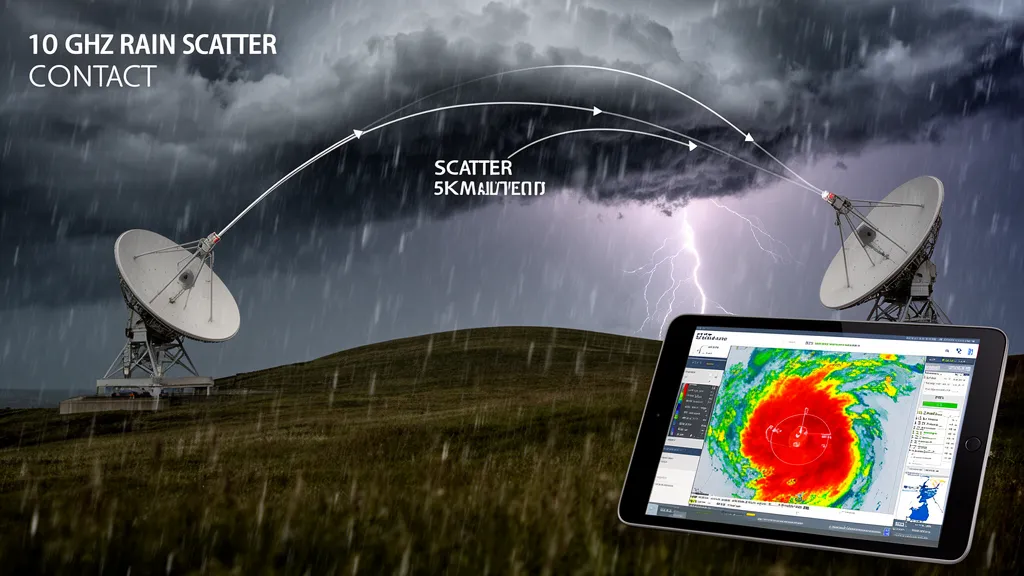
Operator’s Verdict: Rain scatter in brief: Precipitation at 10 GHz acts as a passive scatter relay, enabling contacts of 100–400 km through terrain obstacles. Works during heavy rain and thunderstorms — weather radar is your scheduling tool. Equipment needed: 10 GHz transverter + 60 cm dish + 2–5 watts. ON4KST microwave chat for real-time coordination.
The Physics of Microwave Scattering
At 10 GHz (wavelength = 3 cm), the relationship between the radio wavelength and the physical size of precipitation particles produces powerful scattering effects. Understanding the physics helps explain why rain scatter works so well at 10 GHz and so poorly at lower frequencies.
Mie scattering occurs when the particle size is comparable to the wavelength. For 10 GHz radiation:
- Raindrops (1–5 mm diameter): Mie parameter (πd/λ) ≈ 0.1–0.5 — strong Mie scattering regime
- Hail (10–50 mm): Strong radar targets; very effective scatter
- Wet snow (aggregates): Variable; less effective than liquid rain
The scattering cross-section per raindrop at 10 GHz is orders of magnitude larger than at 1 GHz. A thunderstorm cell containing billions of large raindrops per cubic kilometre presents an effective scatter volume that can illuminate a ground station hundreds of kilometres away.
The scattering is not purely backward (radar-like) — it has a forward-scatter component that spreads energy into a broad cone. This allows signals from one direction to be scattered toward a receiver at a different angle, enabling non-line-of-sight contacts.
Pro Tip: For microwave operators planning rain scatter sessions, DXRadar’s solar weather dashboard helps you avoid days when geomagnetic storms might distract from VHF/UHF operations. Pair weather radar with best-bands-now to decide whether 10 GHz rain scatter or lower-band HF propagation is the better use of your operating time.
Anatomy of a Rain Scatter Contact
A typical rain scatter geometry:
Station A ─────────→ [Rain Cell] ─────────→ Station B
(10 GHz dish)         (at midpoint)          (10 GHz dish)
Both stations point their dishes not at each other (which may not be possible due to terrain), but at the rain cell. The cell scatters energy from A toward B and vice versa.
Key geometry requirements:
- Rain cell must be visible (above horizon) from both stations simultaneously
- Elevation angles are typically 2–15° above horizon
- The scatter volume must be above the freezing level for maximum effectiveness (liquid water scatters far better than ice)
Path lengths: With rain cells at 2–5 km altitude, the maximum contact distance for single-cell scatter is approximately 400–600 km. Longer contacts (600–800 km) have been documented using high convective cells or multi-cell paths.
Weather Radar as a Planning Tool
Rain scatter forecasting relies entirely on precipitation detection:
UK/Ireland: Met Office rain radar (metoffice.gov.uk) provides 5-minute updated maps. The 6-hour composite radar shows developing storms.
Europe: EUMETSAT’s European precipitation radar (Nimbus server) and national services (DWD, KNMI, Météo-France) provide coverage.
North America: NOAA’s radar.weather.gov provides NEXRAD composite coverage with high temporal resolution.
When you see a deep convective cell (dark red on radar — rainfall > 50 mm/hr) positioned between your location and a potential target station, rain scatter contact is likely possible.
Time estimation: Convective cells move with the wind at 10–50 km/h. Track the cell’s position and speed on radar to estimate how long it will remain in a favorable geometry for your specific path.
Equipment for 10 GHz Rain Scatter
Transverter Systems
Most amateur 10 GHz rain scatter stations use a transverter — a frequency-converting module that takes a 144 MHz or 28 MHz IF signal from a conventional transceiver and upconverts it to 10 GHz for transmission, and downconverts 10 GHz received signals back to IF.
DB6NT transverter (DB6NT.de): The standard European design. Available in kit and assembled forms. Produces 100–500 mW at 10 GHz from 28 MHz IF. The MKII version includes a low-noise receive front end.
G3WDG design: Popular UK/European homebrew design.
Gunnplexer modules: Older 10 GHz Gunnplexer oscillators (surplus from commercial communications) are used by some operators but have frequency stability and tuning challenges.
Dish Antennas
| Dish Diameter | Gain (10 GHz) | Beamwidth | Notes |
|---|---|---|---|
| 30 cm | ~24 dBi | 8° | Minimum useful |
| 60 cm | ~30 dBi | 4° | Good all-rounder |
| 90 cm | ~33 dBi | 2.7° | More gain; requires accurate pointing |
| 1.2 m | ~36 dBi | 2° | Competitive; needs precise mount |
| 2.4 m | ~42 dBi | 1° | Serious station |
For rain scatter, accuracy of pointing matters. The scatter volume may span 10–30 km at the rain cell, but a 1° beamwidth dish requires pointing within ±0.5° of the correct bearing and elevation. An azimuth-elevation mount with degree-accurate readout is important for larger dishes.
Power
1–5 watts at 10 GHz is typical for portable rain scatter operations. 50–100 watts (available from travelling-wave tube amplifiers or solid-state PAs) substantially improves range. Given the high antenna gain (30 dBi dish), even 1 watt EIRP is competitive due to the very focused beam.
Operating Rain Scatter Contacts
Pre-contact coordination
Rain scatter requires both stations to be active simultaneously and pointing correctly. Coordination channels:
- ON4KST Microwave Chat (on4kst.com/chat): The primary European microwave coordination chat. Post rain scatter alerts when you see a suitable cell on radar.
- UK Microwave Group reflector (UK operators)
- DX Cluster: Some operators spot 10 GHz rain scatter contacts on the cluster
Post the rain cell location, time, target region, and your grid square on ON4KST chat. Other stations in the potential scatter zone will respond.
Pointing the dish
For rain scatter, you point NOT at the target station but at the rain cell. Calculate or estimate the bearing and elevation to the rain cell from your location, cross-reference with weather radar position data.
During an active scatter event, signals are often strong enough to copy on SSB (voice). Signal reports of 55–59 are common during good events at 200–300 km. FT8 (or JT4 on microwave) extends capability to marginal events.
What signals sound like
Rain scatter signals are often:
- Rapid fluctuation: Raindrops move in the wind, causing fast fading
- Broad Doppler spread: The scatter volume is large and moving, producing a frequency-smeared signal rather than a clean tone
- Sudden onset/offset: As the scatter geometry changes with rain cell movement, signals appear and disappear quickly
On FM (simplex is sometimes used for local 10 GHz rain scatter in Europe), the rapid fading sounds like noise bursts between words.
Rain scatter adds a weather-driven dimension to microwave operating that complements the reliability of tropo ducting. For 10 GHz operators, tracking both weather patterns simultaneously — anticyclones for tropo, convective storms for rain scatter — keeps the band productive across all seasons.
Frequently Asked Questions
What is rain scatter propagation?
Rain scatter is a microwave propagation mode where millimetre-wave and centimetre-wave signals are scattered by precipitation particles (raindrops, hail, wet snow) back toward Earth. At 10 GHz (3 cm wavelength), raindrops with diameters of 1–5 mm are comparable in size to the wavelength, producing strong Mie scattering. Two stations that cannot see each other (due to terrain obstruction or distance) can both illuminate the same rain cell with their beams, using the precipitation as a passive scatter volume. Contacts of 100–400 km are typical; 500+ km has been documented during intense convective storm events. Rain scatter is the primary extended-range propagation mode on 10 GHz.
What frequencies does rain scatter work on?
Rain scatter is most effective at frequencies above 3 GHz, where the wavelength is comparable to or smaller than raindrop size. The primary amateur band for rain scatter is 10 GHz (3 cm, also called ‘3 cm band’ or ‘10.368 GHz region’). Rain scatter also works on 24 GHz and 47 GHz but path loss increases rapidly with frequency and equipment is more specialised. Below 3 GHz, scattering cross-sections decrease and rain scatter is rarely a useful propagation mode. At 144 MHz and 432 MHz, rain causes attenuation rather than useful scatter.
How do I find rain scatter opportunities?
Weather radar is the primary tool for rain scatter planning. When a convective storm (heavy rain, thunderstorm) is located approximately midway between two 10 GHz stations, rain scatter contacts become possible. Check national weather radar (UK: Met Office radar; EU: EUMETSAT/DWD; USA: NOAA radar.weather.gov) for heavy precipitation cells. When you observe an intense storm cell between your location and a target station, immediately call on 10 GHz and listen for rain scatter. The ON4KST microwave chat is the real-time coordination channel — post a rain scatter alert when you see a storm on radar.
What equipment is needed for 10 GHz rain scatter?
A minimal 10 GHz rain scatter station: transverter (converting to/from 144 MHz or 28 MHz IF) + dish antenna of 60 cm diameter or larger + 1–5 watts at 10 GHz. Many operators use Gunnplexer or DB6NT transverter designs. The dish antenna provides high gain and narrow beamwidth — important for pointing at the rain cell scatter volume. Small dishes (30–60 cm, 24–28 dBi) are practical; larger dishes improve performance but require more precise pointing. Signal reports on rain scatter contacts commonly reach 59 during intense events, even at 200–300 km distances.
Is rain scatter weather-dependent in the same way as tropo ducting?
Yes, but in the opposite weather pattern. Tropo ducting requires dry anticyclonic conditions. Rain scatter requires precipitation — heavy convective rain (thunderstorms, heavy showers) is ideal. Frontal rain (slow, widespread, light drizzle) produces weaker rain scatter than intense convective rain, because the drop size distribution is different. The best rain scatter occurs during summer thunderstorm activity, which coincidentally overlaps with periods when tropo ducting is less frequent. The two modes are seasonally complementary: tropo peaks in autumn; rain scatter peaks in summer convective season.