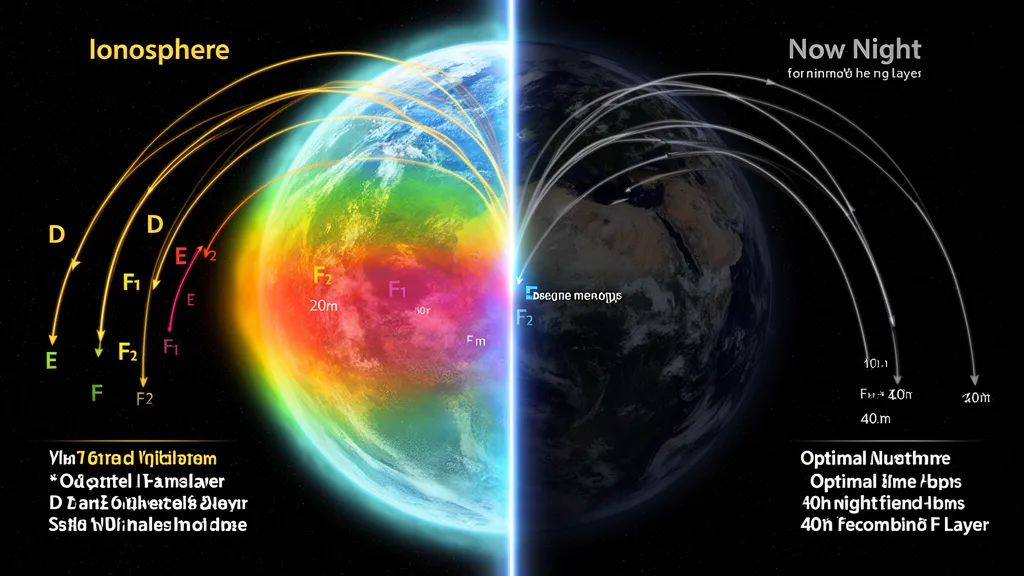
Operator's Verdict: The key rule: Daytime = D-layer kills low bands (160m, 80m), F2 opens high bands (10m, 15m). Nighttime = D-layer gone, low bands open for DX, high bands close on most paths. 20m is the exception that works 24 hours. The gray line (sunrise/sunset) briefly supercharges both.
The Sun as the Master Switch
Every HF band you operate on exists in a state directly controlled by the Sun. Solar ultraviolet and extreme ultraviolet (UV/EUV) radiation ionises the upper atmosphere, creating the ionospheric layers that make long-distance HF communication possible. Importantly, the same solar radiation that enables upper-band propagation also inhibits lower-band propagation.
Understanding this dual role is the foundation of HF band selection.
Pro Tip: Bookmark DXRadar's best bands now page — it tracks time of day relative to each band's optimal window automatically. At sunrise, check the solar weather dashboard for SFI and Kp before deciding whether to chase 10m or settle in on 40m.
The Ionospheric Layers and Their Daily Cycle
The ionosphere consists of four main layers:
| Layer | Altitude | Exists When | Effect on HF |
|---|---|---|---|
| D-layer | 60–90 km | Daytime only | Absorbs signals below ~5 MHz |
| E-layer | 90–150 km | Day (strong), Night (weak) | Reflects up to ~4 MHz |
| F1-layer | 150–200 km | Daytime only | Merges into F2 at night |
| F2-layer | 200–500 km | 24 hours (varies) | Reflects HF signals |
The critical player for daily HF operation is the D-layer. It forms within minutes of local sunrise and dissolves within 30–60 minutes of sunset. While present, it absorbs signals below approximately 5 MHz — 160m (1.8 MHz), 80m (3.5 MHz), and 60m (5 MHz) are effectively blocked for long-distance propagation during daylight hours.
Daytime HF: Which Bands Work
During daylight hours:
- 160m, 80m: D-layer absorption kills skip beyond ~200 km. Only NVIS at close range.
- 60m, 40m: Significant D-layer attenuation. 40m NVIS works; 40m DX is marginal until late afternoon.
- 30m: Moderate absorption; useful for moderate distances.
- 20m: Works well — some D-layer loss but F2 ionisation more than compensates.
- 17m, 15m: Excellent if SFI > 95–100. F2 fully developed by mid-morning.
- 12m, 10m: Open during solar maximum (SFI > 110–120). Typically open 1–2 hours after local sunrise.
Nighttime HF: The Reversal
After sunset:
- D-layer disappears: Within 30–60 minutes of sunset, D-layer electron density drops to negligible levels.
- 160m and 80m open: These bands, liberated from D-layer absorption, can now support long-distance F-layer propagation on paths that are entirely in darkness.
- 40m opens for DX: The classic 40m DX window — roughly 1–2 hours after local sunset until 1–2 hours before local sunrise.
- 20m: Continues working 24/7 due to residual F2 ionisation.
- 15m and 10m: Close on most paths because the F2 layer's MUF drops below their frequencies. Exception: very long paths near the equatorial anomaly may support 15m overnight during solar maximum.
The Day/Night Band Guide
| Band | Best Time | Closes |
|---|---|---|
| 160m | 2–6 hours after sunset | Sunrise; useless by day |
| 80m | Sunset to sunrise | 1–2 hours after sunrise |
| 60m | Night, some NVIS by day | D-layer degrades daytime DX |
| 40m | NVIS by day; DX after sunset | DX window closes near sunrise |
| 30m | Extended, better at night | Marginal during solar high D-layer |
| 20m | 24 hours | Never fully closes |
| 17m | Daytime and early evening | ~2 hours after sunset at SFI<130 |
| 15m | Daytime | Sunset for most paths |
| 12m | Daytime | Sunset for most paths |
| 10m | Daytime peak (SFI>120 required) | Sunset |
The Gray Line: Maximum Enhancement
The gray line (grayline, terminator) is the most powerful propagation enhancer on HF. At the sunset side of the terminator:
- The D-layer is thinning rapidly — its absorption drops to near-zero
- The F2 layer is still fully ionised from the day's UV
- A brief window of 15–30 minutes combines maximum F2 with minimum D-layer absorption
At the sunrise terminator:
- The F2 layer has maintained some residual ionisation through the night
- The D-layer has not yet fully formed — the sun is just rising
- Again, a brief window before D-layer absorption ramps up
The gray line produces the most consistent, spectacular results on 40m (for global DX), 80m (for transatlantic contacts), and 20m (for extensions of the normal propagation window).
Track your local sunrise and the sunrise at your target DX region. Plan contacts for the 30-minute window bracketing both events for maximum gray line advantage.
Monitor current band status at DXRadar's best bands now page — it tracks the current time of day relative to optimal band windows.
Frequently Asked Questions
Why do some bands only work at night?
Bands below about 5 MHz (60m, 80m, 160m) are absorbed during the day by the D-layer — the lowest ionospheric layer at 60–90 km altitude. The D-layer exists only when sunlight is present, forming within minutes of sunrise and dissolving within 30–60 minutes of sunset. Without the D-layer at night, 3.5 MHz and 1.8 MHz signals pass through the lower atmosphere and reflect off the F2 layer, enabling long-distance contacts.
Why do bands like 10m only work during the day?
10m (28 MHz) and 12m (24 MHz) require a densely ionised F2 layer to reflect the signal back to Earth. The F2 layer is ionised primarily by solar UV radiation — its electron density is highest at noon local time when solar elevation is maximum. After sunset, the F2 layer's electron density gradually decreases (it doesn't completely disappear, but the MUF drops). Below SFI 130–140, the MUF falls below 28 MHz after sunset, closing 10m on most paths.
Which band works 24 hours a day?
20 meters (14 MHz) is famous for its 24-hour availability under nearly all solar conditions. The MUF on typical 5,000–10,000 km paths rarely drops below 14 MHz even at solar minimum and at night. During the day, 20m is supported by a well-ionised F2 layer; at night, the residual F2 ionisation (which persists because the recombination rate is slow at F-layer altitudes) maintains support for 20m on many paths.
What is the gray line and why does it enhance propagation?
The gray line (or grayline) is the terminator — the boundary between day and night on Earth's surface. At the gray line, the D-layer (which absorbs low-frequency HF) is in transition: too thin to absorb effectively, while the F2 layer ionisation is still maintained by the just-set (or just-rising) sun. This creates a brief window of typically 15–30 minutes when bands that are normally closed (80m, 40m DX) suddenly open for long-distance contacts. The effect is strongest at the two stations' local sunrise/sunset.
How does the day/night boundary affect long-distance paths?
A path from North America to Australia may cross many time zones — part of the path is in daylight, part in darkness. The MUF along the path is determined by the weakest point of ionisation, which is typically either the darkest (night) or most sunlit (maximum absorption) section. Operators learn that the 'magic time' for long-haul DX on a given band is often when the gray line passes through the mid-path region, briefly optimising conditions across the entire circuit.