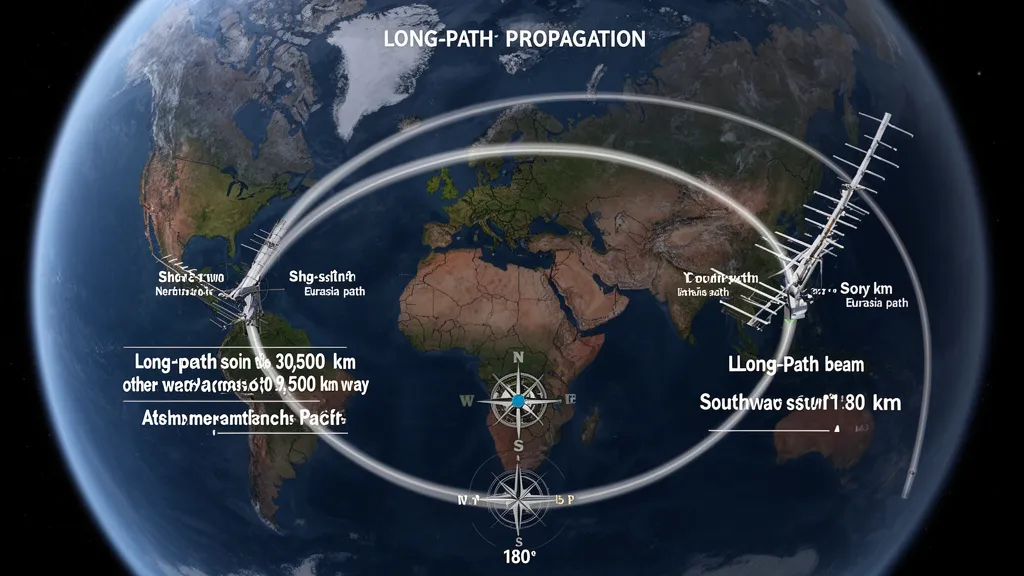
Operator’s Verdict: Long path is not a curiosity — it is an operational technique used daily by serious DXers. When the short path is blocked by polar absorption or a geomagnetic storm, rotate the beam 180°, listen carefully, and transmit. On 20m and 40m at the right time of day, long path often produces stronger signals than the geographically “obvious” short path direction.
What Long Path Propagation Is and Why It Works
Long path propagation sends your HF signal in the opposite direction from the most direct route — around the other side of Earth. Every great circle route between two points has a short path (the shorter arc) and a long path (the complementary arc completing the full circle). The two always sum to 40,075 km — Earth’s circumference at the equator. If the short path is 14,000 km, the long path is 26,075 km.
The physics that makes long path work is identical to short path: F2-layer ionospheric refraction across multiple hops, D-layer absorption as the limiting loss mechanism on lower bands, and MUF as the hard upper frequency boundary. What changes is the geography of the path — which latitude bands the signal crosses, which ionospheric regions it refracts through, and what time of day the midpoints of the path experience.
On radio you notice it immediately. During a geomagnetic storm with Kp 7, every station you’ve been working on the polar short path to Europe goes dead — but rotate 180° and there they are, coming in via the southern long path that bypasses the disturbed high-latitude ionosphere entirely. The signal sounds slightly different: often more hollow, sometimes with a subtle echo, but entirely workable.
Great Circle Geometry and Beam Headings
Both the short path and long path are great circle routes. A great circle is the largest circle that can be drawn on a sphere — it represents the shortest surface distance between two points. When propagation is limited to either path, the beam heading for long path is exactly 180° from the short path bearing.
This is the practical consequence: if your short path to Japan (JA) from central Europe is approximately 330° (north-northwest), your long path heading is 150° (south-southeast). A Yagi or log periodic pointed southeast from Germany working JA on 20m is not aimed at a mistake — it is working the long path via South Asia, the Indian Ocean, Southeast Asia, and the western Pacific.
Most modern logging software — N1MM+, Log4OM, DXKeeper — includes a long/short path calculator in the DX cluster and QRZ lookup displays. The short path bearing and distance appear alongside the long path bearing and distance. Many operators keep this visible at all times.
For directional antenna users, the long path heading check should be part of every operating session on bands where long path is viable. The effort costs nothing — a 180° rotation takes three seconds — and on the right combination of date, time, and solar conditions, the long path signal will be 20 dB stronger than the short path.
Pro Tip: If you’re using FT8 and see a distant station suddenly appear with unusually high SNR in a direction that makes no geographic sense for short path, check the long path bearing. The WSJT-X band activity map doesn’t show beam headings, but a quick long/short path check against the callsign’s prefix will often reveal you’re receiving the long path.
When Long Path Outperforms Short Path
Four conditions make the long path preferable to the short path:
1. High-Latitude Short Path Blocked by Geomagnetic Activity
This is the most common and reliable scenario. When Kp reaches 5 or higher, polar-route short paths between mid-latitude stations (Europe-North America, Europe-Japan, North America-Asia) suffer severe to complete HF blackout from particle precipitation absorption and D-layer enhancement in the auroral oval. The effect is particularly severe on frequencies below 14 MHz.
Meanwhile, a long path that bypasses the polar regions — routing through the equatorial ionosphere via a southerly arc — traverses entirely different ionospheric conditions. At Kp 7, a path from the UK to Japan short path (via Siberia, highly disturbed) may be completely dead while the long path (south through Africa, Indian Ocean, Southeast Asia) delivers a workable signal. The Southern Hemisphere ionosphere experiences geomagnetic effects too, but the equatorial and mid-latitude southern ionosphere is substantially less disrupted than the auroral oval zone.
Monitoring the Kp in real time on DXRadar’s solar weather page before a DX session lets you anticipate when to switch beam headings before the short path dies rather than after.
2. Long Path Passes Through Equatorial F2 Enhancement
The equatorial ionospheric anomaly produces significantly higher foF2 (critical frequency) at magnetic latitudes roughly ±15° from the magnetic equator than at mid-latitudes. The MUF over these regions is routinely 4–6 MHz higher than at 45° N or S, allowing higher frequencies to propagate that would be below the MUF for the entire path if it stayed at mid-latitudes.
A long path from the UK to New Zealand (ZL) routing through North Africa, East Africa, and the Indian Ocean crosses this high-foF2 equatorial belt multiple times. The equatorial F2 enhancement along this arc provides higher per-hop MUF, making 15m viable on this path at times when short-path propagation over the Northern Pacific has collapsed.
NOAA SWPC’s ionospheric maps — and the foF2 data in tools like IRI-2016 — confirm this gradient. The equatorial anomaly peaks at 1–2 hours after local magnetic noon at the anomaly crest and shows strong seasonal variation, being strongest during equinox periods.
3. Gray Line Long Path Alignment
The gray line produces one of the most reliable long path enhancement scenarios. If your QTH and the target DX entity have their gray line windows (sunrise or sunset) within a few hours of each other, the long path between them may simultaneously pass through multiple favorable terminator segments — each hop with reduced D-layer absorption.
From the UK (IO91), the short path to ZL (RF70) is approximately 18,500 km heading east. The long path is approximately 21,575 km heading west/northwest — the difference is less than most operators expect. At UK sunrise in southern autumn (when New Zealand is entering its winter afternoon), this long path arc passes through West Africa, South America, and the Southern Pacific, with several hops coinciding with low D-layer absorption zones.
Japanese operators (JA) exploit this regularly in the opposite direction: JA to Europe long path via the South Pacific, South America, and the Atlantic during JA morning gray line. The short path (westward via Russia) is blocked at that hour by D-layer absorption on the Asian side. The long path via the east, although roughly 26,000 km, frequently works on 20m and 40m. Japanese contest operators build complete European scores on long path contacts during early morning hours.
4. Mutual Antenna Gain
If both stations have directional antennas pointed on long path headings and both transmit simultaneously — as often happens in scheduled skeds — the combined antenna gain advantage over an isotropic reference can reach +12 to +20 dBd, enough to make a marginal path fully workable. This requires prior coordination, but organized DX expeditions to rare entities routinely pre-arrange long path skeds for exactly this reason.
The Echo Effect: Hearing Both Paths Simultaneously
When conditions support propagation on both the short path and long path simultaneously — which occurs on 20m and 40m more often than most operators realize — the received signal exhibits a characteristic echo or reverb on SSB, or doubled dashes on CW.
The physics is straightforward: the signal traveling the short path and the signal traveling the long path arrive at your antenna separated by a time delay proportional to the path length difference. At the speed of light (~300,000 km/s), a path difference of 39,000 km (extreme case — 20,000 km short path vs. 20,000 km long path) would produce a delay of approximately 0.13 seconds. This is clearly audible on voice as a distinct echo, less obvious on FT8 (which uses coherent symbol decoding), and perceptible but subtle on CW.
At more typical path differences of 10,000–20,000 km, the delay is 0.03–0.07 seconds — right in the range where CW dashes sound “fat” or voice sounds like it was recorded in a large reverberant room. Experienced DXers recognize this signature immediately and understand it as a sign that both propagation paths are simultaneously open — often a signal to check whether switching to the long path heading alone would produce a cleaner signal.
Practical Long Path Operating by Band
40m — Night Side Long Path
40m is the most reliable long path band because the path benefit is greatest when the D-layer is absent across most of the route. For this to be true on the long path, most of the ~26,000 km arc must be in darkness. This constrains viable 40m long path to specific time windows where the long path traverses the night-side hemisphere.
From western Europe, 40m long path to VK/ZL works in the UK morning (06:00–08:00 UTC in winter) when the long path arc via West Africa, the South Atlantic, and South America is predominantly dark. From North America (particularly W1/W2), 40m long path to JA works in late afternoon/evening (22:00–01:00 UTC) when the westward long path via Europe, the Middle East, and South Asia is dark.
20m — Equinox Gray Line
20m offers the most consistent long path DX because its MUF requirements are met across a wider range of solar conditions than 15m or 10m. Long path on 20m is most productive:
- During equinox periods (March and September) when the equatorial F2 is at annual peak
- Within 2 hours of either station’s gray line, when the long path partially overlaps the terminator
- When SFI is above 100 SFU, ensuring F2 ionization is sufficient for the full multi-hop path
The example of JA morning gray line long path to Europe applies here: 07:00–09:00 JST (22:00–00:00 UTC), with JA stations pointing east/southeast toward the Pacific long path arc. European stations pointing west/northwest to catch the same arc from the other end. Both ends benefiting from near-terminator conditions.
15m — Solar Maximum Equinox
15m long path becomes viable only during higher solar activity. With SFI above 130–140 SFU, the F2 layer over equatorial regions supports 21 MHz MUF sufficiently for multi-hop long paths. At solar maximum (Cycle 25 peaked ~2024–2025 with SSN exceeding 200), 15m and even 12m showed regular long path openings between Europe and the Pacific. These openings are unpredictable but worth monitoring when SFI is elevated and the equatorial F2 is strong.
Real-World Example: UK to New Zealand Long Path
A worked scenario for context:
QTH: IO91 (southern England, ~51° N, 1° W) Target: RF70 (South Island New Zealand, ~45° S, 168° E)
- Short path: bearing ~016° (north-northeast), distance ~18,600 km, routing via North Asia and the western Pacific
- Long path: bearing ~196° (south-southwest), distance ~21,475 km, routing via France, North Africa, East Africa, the Indian Ocean, southern Australia
Short path bearing of 016° from the UK in March is a northeast heading — across Scandinavia, Russia, the Sea of Okhotsk, and Micronesia to New Zealand. During a geomagnetic storm, this route crosses the auroral oval and a disturbed high-latitude ionosphere. It fails at Kp 5–6 and above.
Long path bearing of 196° heads south-southwest into France, continues over North Africa, East Africa, the Indian Ocean at mid-southern latitudes, passes near southern Australia, and arrives at New Zealand from the northwest. This path stays below 50° S latitude throughout, never crossing the polar regions. During the same Kp 6 storm, this path is usable.
The practical result: UK operators testing both headings on 20m SSB during a G2 storm find ZL9 signals absent on the short path but present at S5 on the long path. Beam 196°, make the contact, beam 016° for comparison — nothing. The 180° difference in heading is not an error; it is the correct technique.
Tools for Long Path Planning
The following tools support long path planning at no cost:
Logging software: N1MM+, Log4OM, and DXKeeper all display both short and long path bearings and distances for any callsign or DXCC entity. Set the display to show both automatically.
Online calculators: The ARRL’s online great circle calculator (arrl.org) accepts coordinates and outputs both paths. DX Atlas (shareware) provides a visual great circle map from any QTH.
Real-time ionospheric data: DXRadar’s solar weather page shows current Kp, SFI, and auroral oval position. When Kp exceeds 4 and your short path crosses high latitudes, switch to long path headings.
PSKReporter: Observing spot patterns on the 20m band condition page can reveal long path propagation empirically — spots arriving from the opposite bearing from what would be expected on short path indicate active long path conditions.
Frequently Asked Questions
What is long path propagation in ham radio?
Long path propagation routes an HF signal in the opposite direction from the more direct short path — the longer of the two great circle arcs between any two points. Because all great circles on Earth total 40,075 km, the long path distance equals 40,075 km minus the short path distance. Long path is preferred when the short path is blocked by polar ionospheric disturbances or when the long path traverses better-ionized equatorial F2 regions.
How do I know when to use long path?
Use long path when Kp is 5 or above and your short path crosses polar regions (Europe-Asia, North America-Pacific), when you hear signals with a distinctive echo or reverb suggesting both paths are active, during gray line sessions where the long path arc is in a favorable position relative to the terminator, or when no signal is found on the short path bearing for a DX entity known to be active.
What does a long path signal sound like?
When both the short path and long path are simultaneously active, the received signal carries a characteristic echo or reverb effect. The short path signal arrives first; the long path signal arrives approximately 0.03–0.13 seconds later. On SSB this sounds like a reverberant room; on CW, dashes may sound double-weighted or “fat.” When only the long path is open, the signal sounds normal — the echo only occurs when both paths are simultaneously carrying signal.
Which bands are best for long path DX?
40m at night, 20m during equinox gray line periods, and 15m at solar maximum are the most productive long path bands. 40m benefits from dark-side low D-layer absorption along the long path arc. 20m and 15m benefit from the equatorial F2 enhancement zone that long paths through the tropics traverse. 80m long paths are occasionally worked but require nearly complete darkness along the entire arc to avoid D-layer absorption.