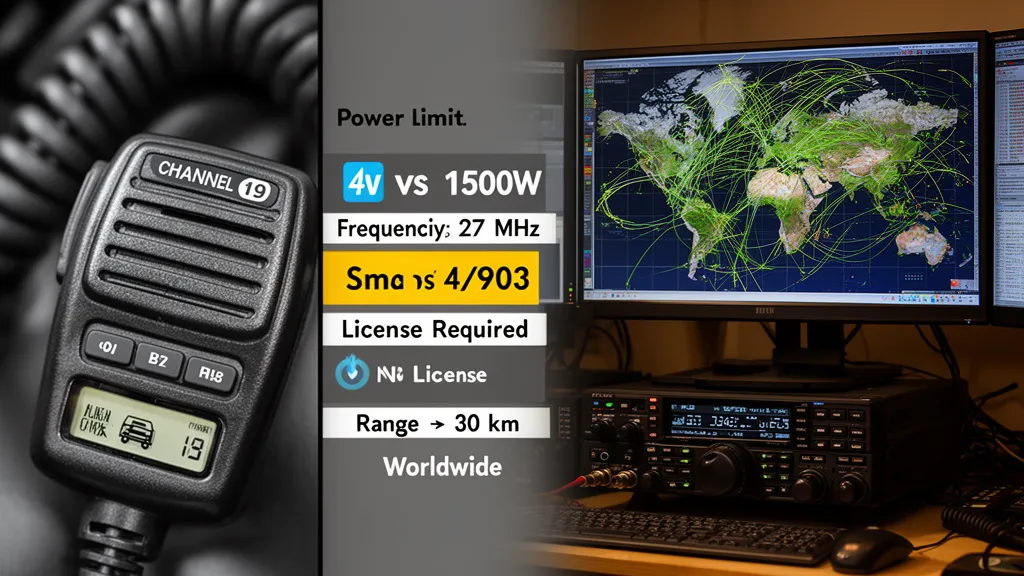
Operator’s Verdict: CB = 40 channels at 27 MHz, 4 watts, no licence, local use (10–30 km normally). Ham radio = dozens of bands, up to 1,500 watts, licence required, designed for worldwide communication. CB is for local utility; amateur radio is a technical hobby with global reach.
Quick Comparison
| Feature | CB Radio | Amateur Radio |
|---|---|---|
| Licence required | No (USA/UK) | Yes — exam required |
| Frequency | 40 channels, 27 MHz | 135 kHz – 250 GHz (many bands) |
| Maximum power | 4W AM / 12W SSB | 1,500W (USA, on most bands) |
| Channels | 40 fixed channels | Entire allocated bands |
| Typical range | 10–30 km | Local to worldwide depending on band |
| Modes permitted | AM, SSB (Ch 36–40) | All modes: voice, CW, digital, data, image |
| Equipment modification | Not permitted | Permitted within rules |
| International use | Restricted/varies | Licensed by country, reciprocal agreements |
| Digital modes | No | Yes — FT8, JS8Call, APRS, AX.25, etc. |
| VHF/UHF operations | No | Yes — 2m, 70cm repeaters and simplex |
| Satellite communications | No | Yes — multiple amateur satellites in orbit |
| Cost to start | $30–100 (handheld) | $100–500 (handheld); $500–2,000 (HF station) |
Pro Tip: Monitor DXRadar’s solar weather dashboard for real-time space weather data — check it before every operating session.
CB Radio: What It’s Good For
CB radio (Citizens Band) was designed for short-range, practical communication accessible to anyone without formal training. Its strengths:
No barriers to entry: Buy a radio, use it. No exam, no registration (in most countries), no learning curve beyond operating the controls.
Trucking and vehicle communication: Channel 19 (USA) is the traditional trucking channel — CB remains widely used by long-haul truckers for road condition reports and traffic warnings.
Practical short-range utility: Farm communication, family coordination during outdoor activities, overlanding and off-road vehicle communication. For applications where a group within 20–30 km needs voice communication, CB is sufficient and simple.
Cost: Entry-level CB radios cost $25–80. No licence fees, no ongoing costs beyond the radio.
Amateur Radio: What It’s Built For
Amateur radio (the formal name of “ham radio”) is designed for technical experimentation, long-distance communication, emergency communications, and spectrum research. Its defining characteristics:
Worldwide communication: HF bands use the ionosphere to reflect signals over thousands of kilometres. An operator with 100 watts and a wire antenna can communicate with any point on Earth under the right conditions.
Experimentation: Part 97 explicitly states that one purpose of amateur radio is to advance the radio art through experimentation. Amateur operators can build their own equipment, develop new digital modes (FT8 was developed by amateur radio operators), experiment with antenna designs, and push the boundaries of radio physics.
Emergency communications: The Amateur Radio Emergency Service (ARES) and RACES provide backup communications during disasters when commercial infrastructure fails. HF radio provides infrastructure-independent communication that CB radio’s limited range and power cannot.
Technical depth: Amateur radio covers everything from AM voice on 40m to EME (moon bounce) on 10 GHz, satellite communications via hand-launched cubesats, digital packet radio networks, and experimental modes in millimetre-wave bands. There is no technical ceiling.
Getting Started with Amateur Radio
If CB’s capabilities are insufficient for your interests — if you want to communicate internationally, explore digital modes, or participate in the broader amateur radio community — the path to a ham licence is straightforward.
USA (FCC):
- Technician licence: One exam (35 questions), multiple choice, passing score 74%. Covers electronics basics, operating rules, safety. Grants VHF/UHF privileges plus limited HF.
- General licence: Second exam beyond Technician. Grants most HF band access.
- Amateur Extra: Third exam. Full privileges, no restrictions.
- Exam fee: approximately $15 per sitting
UK (Ofcom/RSGB):
- Foundation: Entry-level exam + practical. Limited power, most bands.
- Intermediate and Full: Progressive exams with increasing privileges.
Exams are held by local radio clubs and online. The ARRL’s study materials (USA) and RSGB materials (UK) prepare you for the exam efficiently.
The DX Propagation Difference
The most fundamental capability difference between CB and ham radio is long-distance propagation. While CB at 27 MHz can occasionally achieve DX contacts via ionospheric skip during solar maximum — and dedicated CB DXers do pursue this on SSB channels — it’s a marginal activity at the edge of what’s technically permitted.
Amateur radio on 20m (14 MHz) or 10m (28 MHz) is designed for international DX. The frequencies, power limits, and operating conventions are all oriented toward achieving reliable long-distance contacts as a normal operating activity.
When solar flux is high (SFI > 150), as during Solar Cycle 25 maximum in 2024–2026, even CB operators occasionally hear stations from across the Atlantic on 27 MHz. But ham radio operators are working Japan, Australia, and South America on 10m with ease — the same solar conditions producing 10x the DX reach due to higher power and better equipment.
Frequently Asked Questions
What is the main difference between ham radio and CB radio?
The fundamental differences are frequency, power, range, and licence. CB (Citizens Band) radio operates on 40 fixed channels around 27 MHz with a maximum of 4 watts AM or 12 watts SSB output, no licence required in most countries. Ham radio (amateur radio) operates across dozens of frequency bands from 135 kHz to 250 GHz, with power up to 1,500 watts (USA legal max), requiring a licence examination. CB radio typically provides 10–30 km local communication. Ham radio on HF bands can communicate worldwide via ionospheric propagation. Ham radio also encompasses digital modes, satellite communication, VHF/UHF repeaters, and experimental modes that CB cannot approach.
Do I need a licence for CB radio?
In the United States, CB radio requires no individual licence — users operate under a blanket licence granted to the Part 95 rules. In the UK, CB radio on 27 MHz channels (permitted frequencies differ from US allocation) also requires no individual licence. Most countries have similar unlicensed CB radio provisions, though the specific frequencies, channel plans, and power limits vary by country. Amateur radio (ham radio) always requires an individual licence obtained by passing an examination. No licence examination exists for CB; no modification of equipment is permitted, and operation is restricted to the designated CB channels at designated power levels.
Can CB radio communicate worldwide like ham radio?
Under most conditions, no. CB radio at 27 MHz with 4 watts AM is limited to approximately 10–30 km under normal conditions. However, CB radio can achieve long-distance propagation under exceptional conditions — when the ionosphere’s E and F layers reflect 27 MHz, CB signals can travel thousands of kilometres. This is called ‘skip’ propagation, and it does occur during solar maximum and sporadic-E conditions. Some CB operators specifically chase these DX contacts on 27 MHz SSB using higher power amplifiers (which are technically illegal in most jurisdictions but widely used). By contrast, ham radio provides reliable worldwide communication as a design goal, with spectrum and power allocations chosen to support it.
Why does amateur radio require a licence?
Amateur radio requires a licence because the service is granted significant spectrum and power privileges. Licensed amateur radio operators can transmit up to 1,500 watts (USA) on dozens of frequency bands, including frequencies shared with other critical services. The licence examination tests knowledge of operating procedures, FCC regulations, electronics basics, and radio safety. This ensures operators understand how to use their equipment without causing interference to other users of the spectrum. The licensing requirement reflects the reciprocal nature of spectrum access — operators are granted significant capability in exchange for demonstrating competence.
Can I convert between ham radio and CB use?
No — CB radios are legally required to operate only on the designated CB channels at Part 95-compliant power levels. Modifying a CB radio to increase power or change frequency is illegal in the USA (FCC rules) and most other countries. Similarly, amateur radio transceivers may technically be capable of operating on CB frequencies but doing so legally requires using CB channels and power limits. In practice, the two services use completely different radio equipment — CB radios are simple, low-cost transceivers; amateur HF transceivers are sophisticated all-mode, all-band instruments. Using amateur equipment on CB frequencies, even with the correct power and channels, would generally violate Part 97 rules requiring type-accepted equipment for specific services.