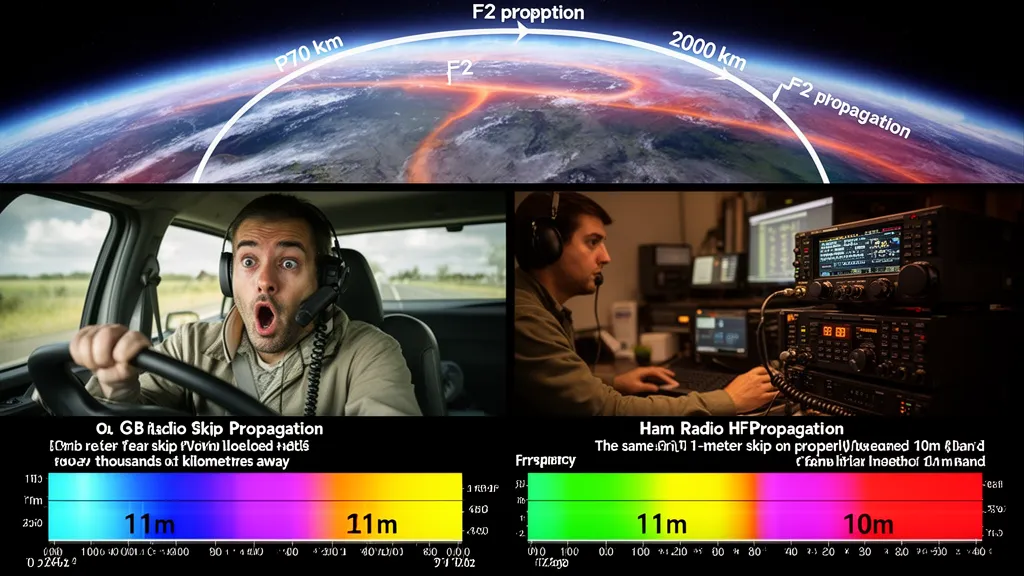
Operator’s Verdict: CB radio at 27 MHz uses identical F2-layer propagation to amateur 10m. At solar maximum (SFI > 120), CB skip goes global — legally, if unintentionally. Amateur 10m is the licensed version of the same phenomenon with 375× more legal power, better antennas, and global communication rights.
CB Radio and the 11 Meter Band
Citizens Band radio operates in 40 channels between 26.965 and 27.405 MHz — a segment known as the “11 meter band” due to its approximately 11-metre wavelength. This places CB immediately below the amateur radio 10m band (28.000–29.700 MHz).
The proximity is not coincidental: when the 27 MHz range was assigned to the Citizens Band Service by the FCC in 1958, the adjacent amateur 10m band was already allocated. The frequencies were chosen in part because the propagation characteristics at 27 MHz are similar to 10m — useful for medium-range communication — but the solar cycle dependency that makes 10m spectacular was less appreciated at the time.
Pro Tip: CB skip and 10m propagation are driven by the same physics. Check the live 10m band status on DXRadar — if 10m is open via F2, CB at 27 MHz is experiencing skip too. Use best bands now to see current conditions across all bands.
How CB Skip Works
Under normal conditions, CB radio provides line-of-sight and limited ground wave coverage of approximately 5–30 km. A standard CB antenna on a vehicle might reliably reach another CB station 20–30 km away.
When solar activity is elevated, however, the F2 layer of the ionosphere (at 200–400 km altitude) becomes sufficiently ionised to reflect 27 MHz signals back to Earth — exactly as it does for amateur 10m signals. This ionospheric reflection is called skip propagation.
A single F2 hop covers approximately 1,500–4,000 km. Multi-hop paths spanning 8,000–15,000 km are possible when the F2 layer is fully developed during solar maximum.
The threshold for significant 11m skip is similar to 10m:
- SFI > 100: Marginal skip, shorter paths possible
- SFI > 120: Regular skip openings, transatlantic possible
- SFI > 140: Extended openings, global paths consistently open
The Solar Cycle Effect
CB operators with experience notice a dramatic difference between solar minimum and solar maximum:
Solar minimum (SFI 70–80): CB operates as a local communications tool. No skip. Useful for driving convoys, rural community links, and local coordination.
Solar maximum (SFI > 130–140): CB channels 38 and 40 (the traditional DX channels, 27.385 and 27.405 MHz) become crowded with distant stations. European operators regularly hear North American CB users and vice versa. Australian operators appear on North American channels during the right UTC hours.
Solar Cycle 25, which peaked in 2025–2026 with SSN regularly above 150 and SFI above 160, produced the best 11m skip propagation since Cycle 23 (1997–2003).
Sporadic-E Skip: Summer Season
Even during solar minimum, CB operators experience skip propagation via sporadic-E (Es) — irregular plasma clouds at 90–120 km altitude that reflect VHF and upper HF signals. Sporadic-E skip on 11m:
- Typically covers 500–2,000 km (single hop) — shorter than F2 skip
- Peaks May–August and December–January in northern hemisphere
- Can appear with no warning and disappear within minutes
- Produces signal strengths of S9+20 dB or more
Sporadic-E on CB is often mistaken for interference by operators unfamiliar with propagation. The sudden appearance of loud foreign voices on channel 19 (the US trucking channel) is classic Es skip.
Regulatory Reality
FCC Part 95 states: “A CB station must not be used to communicate with, or attempt to communicate with, any CB station more than 250 km (155.3 mi) away.” It also prohibits CB contacts with foreign stations.
In practice:
- The FCC has not enforced the distance limitation for ionospheric skip contacts in living memory
- No technology exists to prevent skip propagation — it is a physical phenomenon
- The enforcement focus, where it exists, is on illegal amplifiers and modified transmitters
The only truly illegal aspect of CB DXing is using linear amplifiers (illegal under Part 95) or transmitters modified beyond their type-accepted specifications.
The Amateur Upgrade Path
For CB operators who enjoy the propagation aspects of skip communication, the logical next step is an amateur radio license. The FCC General class license (requires passing two written exams, both multiple-choice) provides:
- Legal access to 10m (28–29.7 MHz) with up to 1,500 watts
- Access to 12m, 15m, 17m, 20m, 40m, 80m, 160m
- International contacts fully legal and encouraged
- No distance restrictions
- SSB, CW, digital, FM, AM modes available
The ARRL study guides are free at arrl.org, and the license exams are administered locally by volunteer examiners. The skip propagation that CB operators experience accidentally is available legally, at much higher power, to any General-class amateur.
Check current 10m conditions (which mirror 11m CB skip) at DXRadar’s is-10m-open page.
Frequently Asked Questions
Why does CB radio skip go so far during solar maximum?
CB radio operates at 26.965–27.405 MHz — just below the amateur 10m band (28–29.7 MHz). At solar maximum, when SFI exceeds approximately 120–130, the F2 layer ionisation is dense enough to reflect 27 MHz signals back to Earth on paths of 1,000–15,000 km. This is the same F2 propagation mechanism that opens the amateur 10m band. CB operators experience ‘skip’ — distant stations suddenly appearing — without any modification to their equipment.
Is CB DX legal?
In the USA, FCC Part 95 technically prohibits CB contacts beyond 250 km (155 miles) and to foreign stations, but enforcement is essentially non-existent for ionospheric skip contacts, which are physically impossible to prevent. However, CB DXing with modified (amplified) equipment is illegal under FCC rules — Part 95 limits CB power to 4 watts AM and 12 watts SSB. In practice, hundreds of thousands of CB operators worldwide engage in informal DX skip contacts, and no enforcement has targeted natural-skip contacts.
How is CB propagation different from amateur 10m propagation?
The physics is identical — both use F2-layer reflection at similar frequencies (27 MHz for CB, 28 MHz for 10m). The practical differences are equipment and regulation: amateur 10m allows up to 1,500 watts (versus CB’s 4–12 watts), better antennas, SSB on all channels, and no distance restrictions. During the same solar conditions that produce spectacular CB skip, amateur 10m operators are simultaneously making global DX contacts with superior SNR and equipment.
When does CB skip happen?
CB skip occurs during elevated solar activity: SFI above approximately 110–120 produces sporadic skip, while SFI above 140 can produce extended global openings. Sporadic-E propagation also causes CB skip, typically in May–August and December–January in the northern hemisphere — shorter hop skip (500–2000 km) that appears suddenly and lasts minutes to an hour. F2 skip at solar maximum can last the entire daylight portion of the day.
Should CB operators get a ham license?
Ham radio provides everything CB provides plus far more: legal high power, all frequencies from 1.8 MHz to above 300 GHz, SSB, digital modes, satellite operation, and the ability to legally communicate internationally. The Technician license is entry-level and achievable with minimal study. The General class license unlocks all HF bands including 10m with 1,500 watts. For CB operators who enjoy skip propagation, upgrading to General gives legal access to a band (10m) that behaves identically to CB at a fraction of the skip conditions required.