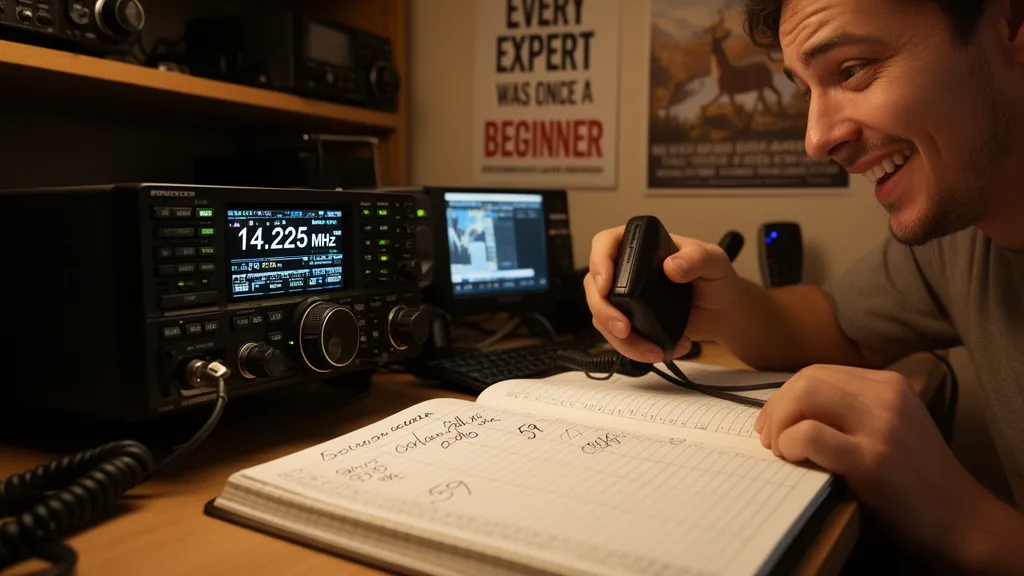
Operator’s Verdict: Listen for a CQ call on 40m (7.200–7.225 MHz SSB in North America) and respond with their callsign then yours. Exchange signal reports and names. 73 to close. Alternatively, use FT8 on 14.074 MHz — the software handles the exchange automatically. Don’t overthink it; the other operator expects beginners and will help.
The Mental Block: Why It Feels Hard
For many new licensees, the radio itself isn’t the challenge — it’s the psychology of transmitting for the first time. What if I do something wrong? What if they can’t understand me? What if I call on the wrong frequency?
The reality: every operator was a beginner once, and the amateur radio community has a long tradition of welcoming new operators. The person you’re calling on 40m has probably heard “first contact” nerves hundreds of times and knows how to help.
With that said, here’s exactly what to do.
Pro Tip: Monitor DXRadar’s solar weather dashboard for real-time space weather data — check it before every operating session.
Step 1: Set Up for Your First Contact
Check propagation: Open DXRadar’s best-bands-now page. If 40m or 20m is showing as active (green or yellow), these are your target bands. 40m (7 MHz) during afternoon/evening and 20m (14 MHz) during the day are the most reliable choices for beginners.
Set your transceiver:
- Mode: USB (Upper Sideband) for voice on 40m and above
- Frequency: 7.200–7.225 MHz (40m SSB, North America) or 14.225 MHz (20m SSB general)
- Power: Start with 50–100 watts (or whatever your licence permits)
- Antenna: Whatever you have connected — even a basic dipole works
Listen first: Before doing anything, listen for at least 5 minutes. You’ll hear other operators making contacts. This gives you a feel for how contacts proceed before you join in.
Step 2: Find Someone Calling CQ
A CQ call sounds like:
“CQ CQ CQ, this is W5XYZ, Whiskey Five X-ray Yankee Zulu, calling CQ CQ CQ, over.”
When you hear a CQ call on a clear frequency, respond. This is much easier than calling CQ yourself because the other station is already expecting to receive a response.
Step 3: Respond to the CQ
When the CQ finishes and there’s a brief pause:
“W5XYZ, this is KD9ABC, Kilo Delta Niner Alpha Bravo Charlie, over.”
Say it once clearly. If they don’t come back to you, wait through their next CQ call and try again. If multiple stations respond, the operator will pick one — if they don’t pick you, try again.
When they acknowledge you:
“KD9ABC, you are 59, 59 into Texas. My name is Jim, Jim, QTH is Dallas, Dallas, Texas. Over to you, over.”
Step 4: The Exchange
A complete basic QSO:
You respond to W5XYZ’s CQ:
“W5XYZ, KD9ABC”
W5XYZ responds:
“KD9ABC, W5XYZ. You’re 57 here, 57, name is Jim, QTH Dallas Texas. Over.”
Your reply:
“W5XYZ, KD9ABC, copy that Jim. You’re 59 into London, England. My name is James, James. Enjoying the 40m band this evening. Over.”
W5XYZ closes:
“James, nice to meet you. 73, W5XYZ, clear.”
You close:
“73 to you Jim, thanks for the contact. KD9ABC, clear.”
That’s a complete contact. Duration: 2–4 minutes. Perfectly normal.
Step 5: Log It
After the contact, record in your log:
- Date and time (UTC)
- Their callsign: W5XYZ
- Frequency: 7.215 MHz
- Mode: SSB
- Signal sent/received: 59/57
- Name and QTH (optional but nice to have)
You can use paper logging or software (WSJT-X, N1MM, Log4OM, etc.). Logging is recommended but not legally required in most jurisdictions.
Alternative: FT8 for Your First Contact
If voice seems daunting, FT8 digital mode makes your first contact simpler than SSB:
- Download WSJT-X from wsjt.sourceforge.io (free)
- Connect your computer to your transceiver (USB or soundcard interface)
- Tune to 14.074 MHz, set mode to USB, power to 25–50 watts
- In WSJT-X, enter your callsign and grid square (e.g., IO91), click Enable TX
- WSJT-X handles the exchange automatically — callsigns, signal reports, confirmations
Your first FT8 contact may happen within minutes. The software does the talking; you just confirm the exchange by clicking the responding station. This is how millions of operators made their first digital contact.
Common Beginner Mistakes to Avoid
Calling on a busy frequency: Always listen for at least 30 seconds before transmitting. If someone is already using the frequency, move a few kHz.
Calling CQ without listening: Call CQ on a clear frequency. Check by asking “Is this frequency in use?” and waiting 5 seconds before calling.
Not giving your callsign enough: FCC Part 97 (USA) requires identifying at least every 10 minutes and at the end of each transmission. Some beginners forget to repeat their callsign during longer exchanges.
Responding too quickly: When someone calls CQ, there’s often a pile of callers. Don’t step on others by calling too fast. Wait for the CQ to fully finish.
Anxiety about mistakes: Expect to make small errors — everyone does. The other operator will usually prompt you if they need you to repeat something. Relax and enjoy the conversation.
Frequently Asked Questions
What do I say during my first HF contact?
The basic HF contact (QSO) follows a simple exchange pattern. If you’re calling someone who called CQ: (1) Respond with their callsign, then yours: ‘W5XYZ, this is KD9ABC.’ (2) When they respond and acknowledge you: exchange signal reports (RST: 59 is excellent, 57 good, 55 acceptable), your name, and your location/QTH. A complete minimal exchange: ‘W5XYZ, KD9ABC, you’re 59 here in London, my name is James, over.’ (3) They respond similarly. (4) Either extend the conversation (rag-chew) or close: ‘73 de KD9ABC, thanks for the contact.’ 73 means best regards in amateur radio shorthand.
What frequency should I use for my first contact?
For SSB voice contacts, use the designated calling frequencies and move off-frequency to have the contact. Standard calling frequencies: 40m SSB = 7.200–7.225 MHz (North America), 7.090 MHz (UK/Europe). 20m SSB = 14.225–14.300 MHz general conversation, 14.150–14.225 MHz DX. Listen first for CQ calls on these frequencies and respond to one, rather than calling CQ yourself when you’re a beginner — it’s less pressure. Alternatively, FT8 digital mode (14.074 MHz on 20m, 7.074 MHz on 40m) makes first contacts extremely simple as the software handles the exchange format automatically.
What is CQ and how do I call it?
CQ is a general call to any station — it means ‘I am looking for a contact with anyone listening.’ A standard CQ call: ‘CQ CQ CQ, this is KD9ABC Kilo Delta Niner Alpha Bravo Charlie, CQ CQ CQ.’ Pause and listen for responses. On HF SSB, call CQ 2–3 times, then listen for 10–15 seconds. Repeat until someone responds, or move to a different frequency if no response after several attempts. Choose a frequency that is clear of other stations by listening for at least 30 seconds first. Calling on a frequency already in use is a common beginner mistake to avoid.
What is the RST signal report system?
RST stands for Readability, Strength, Tone (the last T applies only to CW signals, not SSB voice). For SSB voice, you use RS only: Readability (1–5, where 5 = perfectly readable) and Strength (1–9, where 9 = extremely strong signal). ‘59’ means perfect readability and maximum signal strength — the most common report given in casual contacts. ‘57’ means perfectly readable but moderate signal. ‘55’ means slightly degraded readability and moderate signal. For FT8 and digital modes, the signal report is the SNR (signal-to-noise ratio) in dB, such as ‘-12’ meaning 12 dB below the noise floor.
Do I need to use phonetic alphabet during contacts?
On SSB voice contacts, yes — especially when spelling your callsign or a name that might be ambiguous. The NATO phonetic alphabet is the standard: Alpha, Bravo, Charlie, Delta, Echo, Foxtrot, Golf, Hotel, India, Juliet, Kilo, Lima, Mike, November, Oscar, Papa, Quebec, Romeo, Sierra, Tango, Uniform, Victor, Whiskey, X-ray, Yankee, Zulu. Your callsign KD9ABC would be: ‘Kilo Delta Niner Alpha Bravo Charlie.’ Using the phonetics prevents confusion between similar-sounding letters (B/D, M/N, S/F) over radio static.