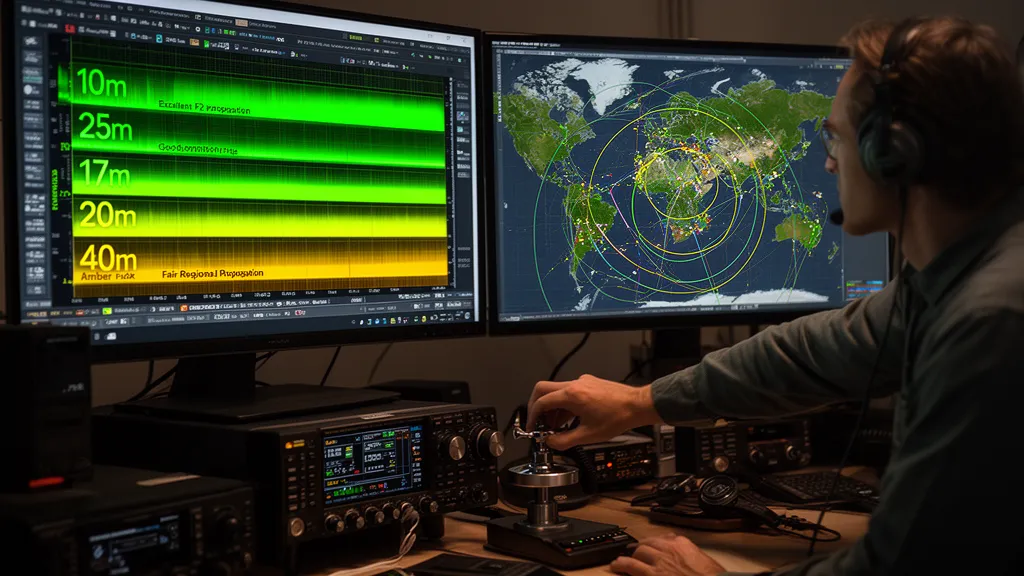
Quick decision framework: Check current SFI and Kp at DXRadar. SFI > 150 + Kp < 3 during daylight = start on 10m. SFI 100–150 = start on 15m or 17m. SFI < 100 = 20m is your workhorse. Night = 20m and 40m. Storm (Kp 4+) = 20m and 40m only, avoid polar paths.
The Three Variables That Determine Which Band Is Best
Every HF band decision reduces to three inputs:
- Solar Flux Index (SFI) — determines whether the F2 layer is ionised enough to support the band's frequency
- K-index (Kp) — determines whether geomagnetic disturbances are absorbing or scattering signals
- Time of day and path geometry — determines whether your path is in daylight (D-layer absorbs low frequencies) or darkness (F2 layer thins for high frequencies)
Pro Tip: Bookmark the DXRadar live band ranking and the solar weather dashboard — check both before every operating session. Thirty seconds of checking SFI and Kp prevents an hour of calling CQ on a dead band.
DXRadar's live band ranking page evaluates all three in real-time and ranks all HF bands by probability of producing DX contacts.
The Decision Flowchart
Step 1: Check SFI
| SFI | Best Bands |
|---|---|
| > 170 | 10m first, then 12m, 15m — may be open simultaneously |
| 140–170 | 10m, 15m excellent; 12m, 17m very good |
| 110–140 | 15m reliable all day; 10m opens midday; 17m, 20m solid |
| 90–110 | 15m morning/midday; 17m, 20m most reliable |
| 70–90 | 20m workhorse; 17m marginal; 40m nights |
| < 70 | 20m (short paths), 40m, 80m at night |
Step 2: Check Kp
If Kp ≥ 4:
- Avoid bands 15m and higher on polar paths (transpolar routes)
- 20m and 40m on mid-latitude paths remain viable
- At Kp 6+: 20m degrades on polar paths; 40m NVIS most reliable
Step 3: Check time of day
| Time (UTC) | Typically Best |
|---|---|
| 0000–0600 | 20m, 40m (DX), 80m (regional) |
| 0600–1200 | 20m, 15m (opening), 10m (if SFI high) |
| 1200–1800 | 10m, 15m, 17m, 20m — all potentially open simultaneously |
| 1800–2400 | 20m, 40m (DX opening), 10m/15m closing |
These are approximate UTC times for mid-latitude North American stations. European stations shift approximately 2 hours earlier.
How DXRadar Calculates the Best Band
DXRadar's band score algorithm considers:
- Current SFI (updated every 10 minutes from NOAA)
- Current Kp (3-hour planetary average)
- Estimated MUF based on SFI using the simplified formula: foF2 ≈ 0.01 × √(SFI × 10^8)
- Time-of-day weighting (D-layer absorption penalty for low frequencies during day)
- Historical spot activity from PSKReporter for current conditions
Bands are ranked EXCELLENT / GOOD / FAIR / POOR and shown on the live band board. The ranking updates automatically with changing conditions.
Quick Reference: Band Characteristics
| Band | Frequency | Works at SFI | Best Time | DX Range |
|---|---|---|---|---|
| 10m | 28 MHz | > 120 | Day only | Global when open |
| 12m | 24 MHz | > 110 | Day only | Global when open |
| 15m | 21 MHz | > 100 | Day, eve | Global |
| 17m | 18 MHz | > 95 | Day, eve | Global |
| 20m | 14 MHz | > 70 | 24 hours | Global always |
| 30m | 10 MHz | Any | Night best | Regional/inter |
| 40m | 7 MHz | Any | Night DX | NVIS day, DX night |
| 80m | 3.5 MHz | Any | Night only | Regional/DX night |
| 160m | 1.8 MHz | Any | Night only | Challenging DX |
When Nothing Seems to Work
If DXRadar shows all bands POOR and you hear nothing:
- Check Kp — if Kp ≥ 5, this is the most likely cause
- Check X-ray flux — if an M or X-class flare occurred in the last 2–4 hours, D-layer absorption may be active on the sunlit side
- Try 40m NVIS — regional paths (< 800 km) often survive when DX bands are dead
- Try 20m FT8 — digital modes work at SNR values 20+ dB below audible SSB signals; a "dead" 20m may still support FT8 contacts
- Check time of day — if it's 1400–2000 UTC and you're in North America, you may be between openings (European paths closing, Asian paths not yet open)
The why are bands dead page gives a real-time diagnosis with current X-ray flux and Kp context.
Frequently Asked Questions
Which HF band is best right now?
The best band depends on current SFI, Kp index, time of day, and your target path. Check DXRadar's live band rankings at /best-bands-now for a real-time ranked list. As a quick guide: SFI > 150 and Kp < 3 during daylight → try 10m and 15m first. SFI 100–150 → 15m and 20m most reliable. SFI < 100 or nighttime → 20m and 40m. During geomagnetic storms (Kp 4+) → 20m and 40m, avoid polar paths.
What SFI do I need for the different HF bands?
As a practical guide: 10m (28 MHz) needs SFI > 120 for reliable F2 DX; 12m needs SFI > 110; 15m needs SFI > 100; 17m needs SFI > 95; 20m works at any SFI above 70; 30m and 40m work at any SFI; 80m and 160m work at any SFI (but best at night). These are approximate thresholds for mid-latitude 5,000+ km DX paths. Shorter paths and digital modes (FT8) work at lower SFI values.
What is a good K-index for HF propagation?
Kp 0–2 is ideal — geomagnetically quiet, F2 ionisation is stable. Kp 3 begins minor degradation on high-latitude polar paths. Kp 4 degrades transpolar paths noticeably. Kp 5+ (G1 storm) causes significant disruption on paths through the auroral zone. Kp 7+ (G3 storm) can affect even mid-latitude paths. Below Kp 3 is the sweet spot for HF DX.
Does the best band change by time of day?
Yes, significantly. During daytime UTC hours: 10m, 12m, 15m, 17m are supported by F2 ionisation. After sunset: 10m and 15m close on most paths. 20m transitions to overnight DX mode. 40m opens for DX on paths in darkness. 80m opens for regional and moderate DX. The gray line (sunrise/sunset boundary) produces enhanced openings on all bands for approximately 30 minutes.
Why can I hear a signal but not make a contact?
This is the skip zone problem. The band may be open for a path that is longer than the distance to the station you hear. At the skip distance boundary, signals from certain distances cannot reach you via the ionosphere. Try calling CQ — your signal may reach that station on the second or third hop even if their signal arrives via a different path. Also consider that they may be running high power and you are running low.