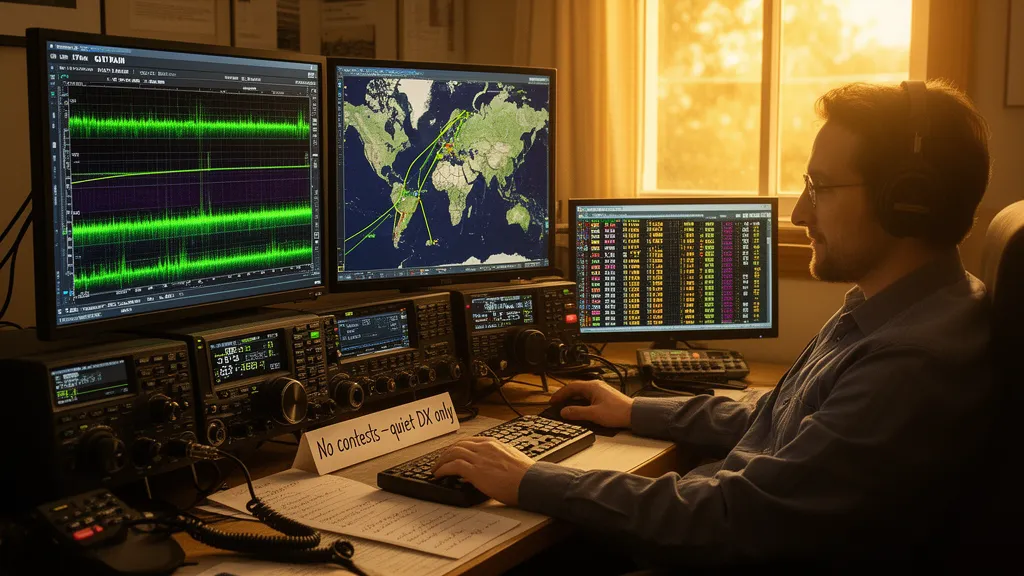
Operator's Verdict: 17m behaves like 15m but without the contest chaos. During major HF contests, when 15m and 20m are saturated, 17m remains a DXer's paradise — quiet, open, and full of rare entities looking for contacts. If you want more DX per hour, add 17m to your rotation.
What Makes 17m Different
The 17 meter band (18.068–18.168 MHz) is one of three WARC (World Administrative Radio Conference) bands allocated exclusively for amateur radio use since 1979. The WARC bands — 30m, 17m, and 12m — share a defining rule: no organised contests. By international agreement, no radio sporting event with competitive elements may operate on these frequencies.
This single rule makes 17m one of the most enjoyable bands on the HF dial. On a typical CQ WW weekend, when 15m is packed three-deep with contest stations every 2 kHz, 17m hosts rare DX entities, island expedition stations, and unhurried operators making long QSOs. The contrast is dramatic.
Pro Tip: During major HF contests, check the live 17m band status — while 15m and 20m are saturated with contest QRM, 17m often carries the rare DX entities that moved to avoid the pile-ups. Use the best bands now page to confirm 17m is open before dedicating operating time.
Propagation Characteristics
17m propagates primarily via F2-layer reflection, behaving similarly to 15m but with slightly more resilience at lower SFI values:
| SFI Level | 15m Status | 17m Status |
|---|---|---|
| 70–90 | Marginal, short paths only | Usable on many mid-latitude paths |
| 90–120 | Good on most paths | Excellent on most paths |
| 120–160 | Excellent | Excellent, opens earlier/closes later |
| 160+ | Outstanding | Outstanding, occasional 24-hour opening |
The MUF on typical 5,000–10,000 km paths must reach 18 MHz for 17m to support F2 propagation. This requires a minimum SFI of approximately 90–100 at mid-latitudes. Below SFI 80, 17m becomes unreliable on long paths.
During solar maximum (SFI > 150), 17m can remain open through the night on favored paths, and occasionally supports propagation even across the polar cap — a capability reserved for the higher bands during typical conditions.
Band Segments
| Mode | Frequency Range |
|---|---|
| CW | 18.068–18.110 MHz |
| Digital (FT8) | 18.100 MHz |
| Digital (JS8) | 18.104 MHz |
| WSPR | 18.1046 MHz |
| Phone (SSB) | 18.110–18.168 MHz |
| SSB calling (informal) | 18.130–18.140 MHz |
Note that 17m is narrow — only 100 kHz. On a busy day during solar maximum, the phone segment (58 kHz) can be very crowded. Scanning the full CW and phone segments takes only seconds with a fast VFO.
Best Times to Operate 17m
For European paths from North America: 17m opens to Europe during morning daylight hours, typically around 1300–1800 UTC. The opening often persists through midday as F2 ionisation is maintained by solar UV. It begins to close as the sun sets in Europe (1800–2000 UTC in summer, 1500–1700 UTC in winter).
For Pacific paths from North America: 17m opens to Japan and the Pacific roughly 2000–2400 UTC in winter, later in summer (0000–0300 UTC). Paths to Australia/Oceania are often best in early UTC morning hours.
Gray line periods (sunrise and sunset at path endpoints) consistently produce enhanced 17m openings. Monitor 17m during the 30 minutes bracketing your local sunrise for optimal long-path contacts.
17m During Contest Weekends
Perhaps the most underrated advantage of 17m is its contest-free status during major contest weekends. During CQ WW SSB or CW (last full weekend of October/November), the situation on the main contest bands is:
- 10m, 15m, 20m, 40m, 80m, 160m: saturated with contest stations, calling frequencies disrupted
- 17m: normal DX activity, often enhanced because operators avoiding the contest melee gravitate here
- Rare DXCC entities on DXpeditions will often move to 17m during contest weekends to continue working non-contest stations
If you are working a particular DXCC entity during a major contest and the entity disappears from 15m and 20m into contest pileups, check 17m. Many serious DX operators spend contest weekends exclusively on WARC bands.
DXCC Hunting on 17m
17m is the preferred secondary band for many DXCC entities, particularly small Pacific islands and rare African countries. The propagation characteristics — open during business hours, no contest interference, manageable noise floor — make it appealing for DXpeditions operating with limited time and equipment.
For the DXCC award, each band counts separately — a contact with a new entity on 17m counts as a band-endorsement credit even if you have already worked that entity on 20m. Operators aiming for the DXCC Honor Roll or high All-Time record prioritise working entities on as many bands as possible, which makes 17m worth monitoring whenever a rare DXpedition is active.
Antenna Requirements
A half-wave dipole on 17m is approximately 8.25 metres (27 feet) per side — a compact, easily deployable antenna. At typical HF station heights of 10–15 metres, a 17m dipole provides a good radiation angle for mid-range DX paths.
Multi-band alternatives:
- A 40m dipole can be loaded on 17m with a wide-range antenna tuner (it is not resonant — the third harmonic of 40m is ~21.3 MHz, which falls on 15m, not 17m)
- Hex beam antennas typically include 17m as a standard element
- Most commercial fan dipoles and trap verticals include 17m
Check current 17m conditions via the DXRadar band conditions page before calling CQ.
Frequently Asked Questions
What SFI is needed for 17 meters to open?
An SFI above 100 typically enables reliable 17m (18 MHz) DX propagation on mid-latitude paths. Above SFI 130, 17m is consistently open during daylight hours on most paths. During solar minimum (SFI 70–80), 17m is still usable on shorter paths and maintains some F2 propagation, though reliability decreases significantly on long paths above 10,000 km.
Why is 17m called a WARC band?
The 17m (18.068–18.168 MHz), 12m (24.890–24.990 MHz), and 30m (10.100–10.150 MHz) bands were allocated to amateur radio at the 1979 World Administrative Radio Conference (WARC) in Geneva. By international agreement, these bands are contest-free — no sanctioned HF contest competitions are allowed on them. This makes them unusually quiet and pleasant for DX operating.
Is 17m better than 15m or 20m?
17m sits between 15m and 20m in propagation behavior. It has slightly better low-SFI performance than 15m but doesn't stay open as late into the evening as 20m. Its key advantage over both is the lack of contest QRM — during major HF contests (CQ WW, ARRL DX), when 15m and 20m are wall-to-wall contest stations, 17m remains calm and DX-rich. For dedicated DXers hunting specific entities, it's often the best choice during contest weekends.
How narrow is the 17m band?
17m is just 100 kHz wide (18.068–18.168 MHz), compared to 450 kHz on 15m and 350 kHz on 20m. This narrow allocation means you need to search a shorter range to find activity, but it also means the band can feel crowded when open during solar maximum. The CW segment is 18.068–18.110 MHz (42 kHz) and the phone/digital segment is 18.110–18.168 MHz (58 kHz).
What are the FT8 and digital frequencies on 17m?
FT8 on 17m is at 18.100 MHz. JS8Call operates at 18.104 MHz. WSPR beacons use 18.1046 MHz. The digital modes cluster at the low end of the phone segment, keeping SSB calling and DX operating in the 18.130–18.160 MHz range.