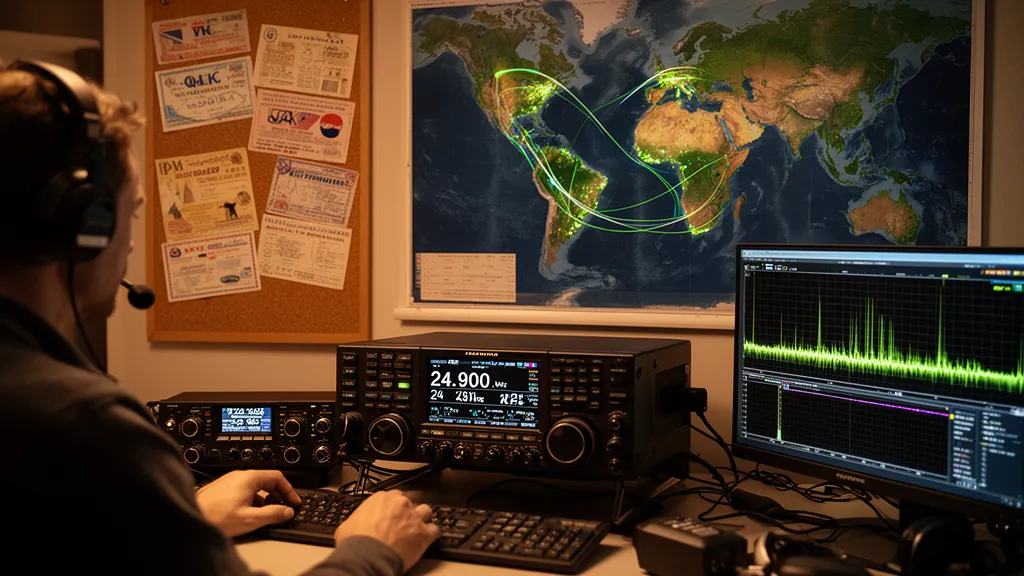
Operator's Verdict: 12m (24 MHz) needs SFI ~120+ for reliable F2 DX. It opens before 10m at solar maximum and stays useful longer. As a no-contest WARC band, it's significantly quieter than 10m — ideal for DXers who want productive contacts without pileup chaos.
The Forgotten Band
The 12 meter band (24.890–24.990 MHz) sits between the popular 10m and 15m bands in frequency, yet it attracts a fraction of the traffic of either. It is a WARC band — allocated at the 1979 World Administrative Radio Conference — and therefore exempt from organised HF contest operation by international agreement.
This exemption, combined with a narrow 100 kHz allocation, leaves 12m genuinely underused on most days. Operators who learn to monitor it are often rewarded with easy DX contacts on entities that are impossible to work on 10m and 15m due to pile-up intensity.
Pro Tip: Check the live 12m band status on DXRadar before scanning the band — PSKReporter spots will tell you instantly if 12m is open. When 10m is marginal but not quite working, check which bands are best right now — 12m often opens 30–60 minutes before 10m.
Propagation Behaviour
12m propagates almost exclusively via F2-layer reflection during daylight hours. Like 10m, it requires elevated solar activity to reliably support long-distance propagation, but the threshold is slightly lower:
| Solar Condition | 12m Status |
|---|---|
| SFI < 90 | Closed (Es possible in summer) |
| SFI 90–110 | Marginal, short favored paths only |
| SFI 110–130 | Good propagation on most mid-latitude paths |
| SFI 130–160 | Excellent, opens earlier and closes later |
| SFI > 160 | Outstanding, possible night openings on favored paths |
The key threshold distinguishing 12m from 10m: at SFI 110–120, 12m opens while 10m is still marginal. When Solar Cycle 25 is ascending and operators report 10m "just starting to open," 12m is often already producing solid DX.
Daily Opening Pattern
On a typical solar-maximum weekday with SFI 150:
- 0800–1000 UTC: 12m opens from North America toward Europe as daylight reaches the mid-path ionosphere
- 1000–1800 UTC: Peak propagation, multiple continental paths simultaneously open
- 1800–2000 UTC: Opens toward Pacific/Asia as the path rotates into daylight
- 2000+ UTC: Begins to close as the F2 layer thins on the sunset side
Compared to 10m (28 MHz), 12m typically opens 30–60 minutes earlier in the morning and closes 30–60 minutes later in the evening — a meaningful difference for operators with limited operating windows.
Operating Segments
| Mode | Frequency |
|---|---|
| CW (general) | 24.890–24.930 MHz |
| CW (DX window) | 24.890–24.895 MHz |
| FT8 | 24.915 MHz |
| WSPR | 24.9246 MHz |
| Phone (SSB) | 24.930–24.990 MHz |
| SSB calling (informal) | 24.940–24.950 MHz |
The entire band is only 100 kHz wide. On a busy day, you can scan the complete phone segment in under a minute.
The DX Advantage
During major HF contests (CQ WW, ARRL DX), the situation on contest bands is:
- 10m, 15m: often packed, calling frequencies disrupted, QRM from both directions
- 12m: quiet, DXpeditions operating normally, no contest stations
Many organised DXpeditions to rare entities specifically allocate operating time to WARC bands to serve the non-contest community. If a Pacific island entity is announced with 12m operations, the pileup on 12m will be a fraction of the pileup on 10m.
For DXCC hunters, 12m band endorsements are among the most achievable during solar maximum — entities that are impossible on 10m due to competition are often workable on 12m.
Antenna Considerations
A half-wave dipole for 12m is approximately 5.9 metres per side — very manageable. At typical station heights of 8–12 metres, the radiation angle is suitable for DX propagation.
Most modern HF transceivers with antenna tuners will load a 10m dipole on 12m reasonably well, as will a 40m dipole at its third harmonic. Dedicated 12m antennas are uncommon but rewarding; alternatively, including 12m in a fan dipole or trap antenna design is straightforward.
Frequently Asked Questions
What SFI is needed for 12 meters to open?
An SFI of approximately 120 or higher typically enables reliable 12m (24 MHz) F2 DX propagation on mid-latitude paths. Between SFI 100–120, 12m may open on favorable short paths but is unreliable. Below SFI 90, 12m is largely inactive except for sporadic-E openings.
Is 12m better or worse than 10m for DX?
12m requires a slightly lower SFI to open compared to 10m and typically provides a slightly longer daily opening window. When 10m (28 MHz) is marginal at the start of a solar maximum, 12m (24 MHz) often opens first. However, 10m is more spectacular when conditions are excellent — shorter skip distances, more stations active, more contest activity. 12m is the quieter, more consistent alternative.
Why do so few people use 12m?
12m is a WARC band (allocated at the 1979 World Administrative Radio Conference), so it has no contest activity by international agreement. With no contests to drive activity, many operators simply forget about it. Additionally, 12m has a narrow 100 kHz allocation, and older transceiver models sometimes have poorer filter options for it. The result is that 12m is genuinely underused — which is actually an advantage for DXers who know about it.
What modes are used on 12m?
CW occupies 24.890–24.930 MHz, with phone (SSB) from 24.930–24.990 MHz. FT8 on 12m is at 24.915 MHz. WSPR beacons use 24.9246 MHz. The band is narrow at 100 kHz, so digital and CW activity coexist in the lower half while SSB operates in the upper 60 kHz.
Is 12m useful during solar minimum?
At solar minimum (SFI < 80), 12m is mostly closed for F2 DX and sits quiet. However, sporadic-E propagation can briefly open 12m, particularly in summer (May–August in the northern hemisphere). These openings are unpredictable but can produce spectacular single-hop contacts to 1,500–3,000 km distances. The 12m sporadic-E season broadly overlaps with the 10m Es season.
Summary
12 meters is an underrated asset during the upper half of the solar cycle. Its WARC status, lower SFI threshold versus 10m, and genuinely sparse activity make it one of the best bands for productive, low-stress DX operating. If you are focused on DXCC entity count and have 10m and 15m covered, add 12m to your operating plan during solar maximum.
Monitor current 12m conditions at DXRadar's real-time band board.