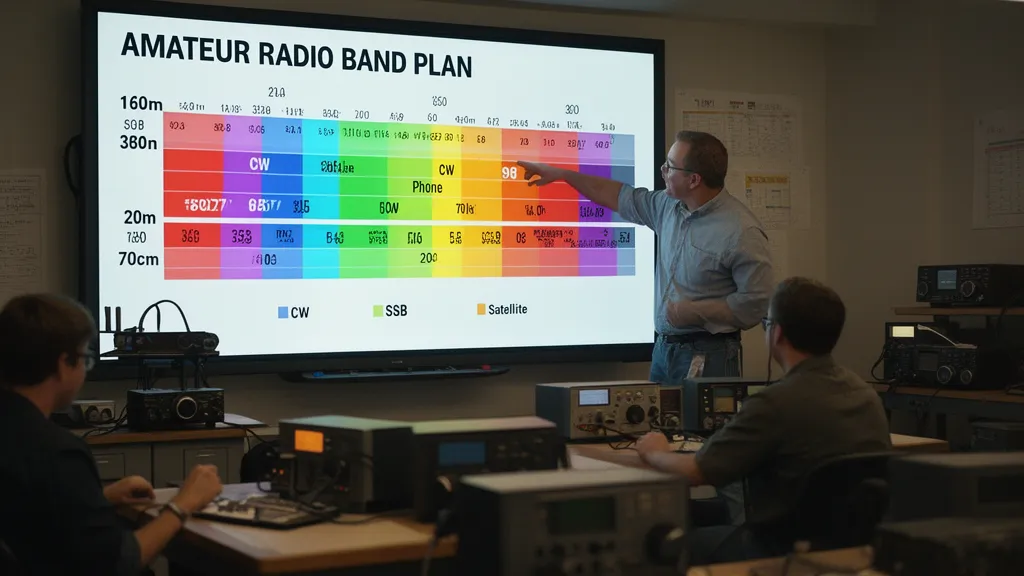
What you need to know: Band plans divide each amateur band into mode segments (CW at the bottom, digital in the middle, SSB phone above) by voluntary international agreement. They aren’t laws, but violating them causes QRM to other operators and marks you as an inconsiderate newcomer.
Why Band Plans Exist
When amateur radio operators share a licensed frequency band, they need a coordination mechanism. Without a plan, a phone (SSB) station might transmit in the CW segment and cause 30 dB of broadband QRM to several narrowband CW contacts simultaneously. With a plan, everyone knows where to look for which mode.
Band plans are developed and maintained by the International Amateur Radio Union (IARU) in coordination with national societies like ARRL (USA), RSGB (UK), and DARC (Germany). They are not legally binding — the FCC, Ofcom, and other regulators care only about the licensed band edges, not sub-band assignments — but nearly all operators follow them because the alternative is chaos.
Pro Tip: Knowing the band plan helps, but knowing which band to use matters more. Check DXRadar’s best bands now to see which bands are open before you tune to any frequency. The solar weather dashboard shows the current SFI and Kp driving those conditions.
The HF Band Plan Overview
160 Meters (1.800–2.000 MHz)
| Segment | Use |
|---|---|
| 1.800–1.830 | CW (extra-class only in USA) |
| 1.830–1.840 | CW/QRP |
| 1.840–2.000 | Phone (SSB) and digital |
| 1.900 | SSB calling (informal) |
160m is a night band — D-layer absorption makes daytime operation nearly useless except for very short paths. Best DX window: 2–6 hours after local sunset.
80 Meters (3.500–4.000 MHz)
| Segment | Use (Region 2/Americas) |
|---|---|
| 3.500–3.600 | CW |
| 3.570–3.600 | RTTY/digital |
| 3.600–4.000 | Phone (SSB) |
| 3.985 | SSB calling (North America) |
| 3.750 | ARES/EmComm (North America) |
80m is primarily a night DX band, though NVIS regional coverage extends to daytime at shorter distances. Significant noise from atmospheric static, especially in summer.
40 Meters (7.000–7.300 MHz)
| Segment | Use (Region 2/Americas) |
|---|---|
| 7.000–7.125 | CW |
| 7.040–7.060 | RTTY/digital |
| 7.074 | FT8 |
| 7.125–7.300 | Phone (SSB) |
| 7.200 | SSB calling (North America) |
| 7.290 | ARES/EmComm (North America) |
Note: Region 1 (Europe) phone starts at 7.100, creating a conflict zone 7.100–7.125 MHz.
30 Meters (10.100–10.150 MHz) — WARC Band
| Segment | Use |
|---|---|
| 10.100–10.130 | CW only |
| 10.130–10.150 | RTTY/digital (no phone allowed) |
| 10.140 | WSPR beacons |
No phone allowed on 30m by IARU agreement. CW and digital only. Excellent low-noise DX band.
20 Meters (14.000–14.350 MHz)
| Segment | Use |
|---|---|
| 14.000–14.150 | CW |
| 14.070–14.099 | RTTY/digital |
| 14.074 | FT8 |
| 14.100 | NCDXF/IARU beacons |
| 14.150–14.350 | Phone (SSB) |
| 14.225 | SSB calling |
| 14.300 | Maritime mobile / emergency |
20m is the busiest amateur band globally and the primary DX band — open 24 hours under most conditions.
17 Meters (18.068–18.168 MHz) — WARC Band
| Segment | Use |
|---|---|
| 18.068–18.110 | CW |
| 18.100 | FT8 |
| 18.110–18.168 | Phone (SSB) |
Contest-free by IARU policy. No formal calling frequency — most operators tune and scan.
15 Meters (21.000–21.450 MHz)
| Segment | Use |
|---|---|
| 21.000–21.200 | CW |
| 21.070–21.110 | RTTY/digital |
| 21.074 | FT8 |
| 21.150 | NCDXF/IARU beacons |
| 21.200–21.450 | Phone (SSB) |
| 21.285 | SSB calling |
12 Meters (24.890–24.990 MHz) — WARC Band
| Segment | Use |
|---|---|
| 24.890–24.930 | CW |
| 24.915 | FT8 |
| 24.930–24.990 | Phone (SSB) |
10 Meters (28.000–29.700 MHz)
| Segment | Use |
|---|---|
| 28.000–28.300 | CW |
| 28.070–28.190 | RTTY/digital |
| 28.074 | FT8 |
| 28.200 | NCDXF/IARU beacons |
| 28.300–29.300 | Phone (SSB) |
| 28.400 | SSB calling |
| 28.885 | SSB calling (alternative) |
| 29.000–29.200 | AM |
| 29.300–29.510 | Satellite downlinks |
| 29.520–29.590 | FM repeater inputs |
| 29.620–29.700 | FM repeater outputs |
10m is the widest HF band at 1.7 MHz. In addition to HF DX, it includes AM, FM, and satellite segments.
Key Operating Conventions
Listen before transmitting: Always listen for at least 30 seconds before transmitting on any frequency, and announce “Is the frequency in use?” before calling CQ.
QSY after QSO: After using a calling frequency to establish contact, move to a clear working frequency for the actual contact. Calling frequencies should remain available for others.
CW segment respect: Phone operators must stay above the CW segment. A 2.7 kHz-wide USB signal centred at 14.140 MHz will put significant energy into the CW segment. Stay above 14.150 MHz for phone.
Priority communications: Certain frequencies are reserved for emergency communications globally — 14.300 MHz (20m maritime mobile/international distress), 3.750 MHz (80m ARES), and others. Monitor these even if you don’t need them.
Check which bands are currently open via DXRadar’s live band conditions.
Frequently Asked Questions
What is a ham radio band plan?
A band plan is a voluntary agreement among amateur radio operators about how to sub-divide a licensed frequency band by mode. The ITU allocates a frequency range to the amateur service (e.g., 14.000–14.350 MHz for 20m), and the band plan specifies conventions within that range: CW at the bottom, digital modes in the middle, SSB phone above, calling frequencies at specific spots. Band plans are not FCC regulations — they are gentlemen’s agreements that most operators follow to reduce interference.
What is the difference between IARU Regions 1, 2, and 3?
The International Amateur Radio Union divides the world into three regions for band planning purposes: Region 1 (Europe, Africa, Middle East, Northern Asia), Region 2 (Americas), and Region 3 (Asia-Pacific, Australasia). Each region has slightly different sub-band allocations for the same frequency ranges. The most significant difference is on 40m, where phone privileges differ — Region 2 allows phone from 7.125–7.300 MHz while Regions 1 and 3 have phone from 7.100–7.200 MHz.
Why is CW always at the bottom of the band?
By long-standing convention and IARU agreement, CW (Morse code) occupies the lowest segment of each HF band. This arrangement predates SSB and digital modes. CW requires less bandwidth (~100–500 Hz per signal) than SSB (~2.7 kHz) or AM (~6 kHz), so placing narrow-bandwidth modes together at the band bottom and wide-bandwidth modes above minimizes interference. Phone operators who tune into the CW segment accidentally will cause significant QRM to multiple CW contacts.
What are the calling frequencies?
Calling frequencies are traditional meeting points where operators call CQ and listen for contacts before moving off to a working frequency. Key HF calling frequencies: 14.225 MHz (20m SSB), 21.285 MHz (15m SSB), 28.400 MHz (10m SSB), 7.200 MHz (40m SSB, North America), 3.985 MHz (80m SSB, North America). After making contact, the convention is to QSY (move) to a clear frequency for your actual conversation.
What are WARC bands and why can’t contests use them?
The WARC bands (30m: 10.100–10.150 MHz; 17m: 18.068–18.168 MHz; 12m: 24.890–24.990 MHz) were allocated to amateur radio at the 1979 World Administrative Radio Conference in Geneva. As a condition of the new allocations, the amateur community agreed internationally that these bands would be contest-free. This is an IARU policy, not an ITU regulation, but virtually all sponsored HF contests exclude WARC bands from their exchange categories.